第 2 章 · 简单句的类型与变形
一句话:一个主谓结构就是一个简单句;按“用来做什么”分陈述、疑问、祈使、感叹四种,再加否定、there be、强调、倒装等变形。
2.1 一张图看懂
Section titled “2.1 一张图看懂”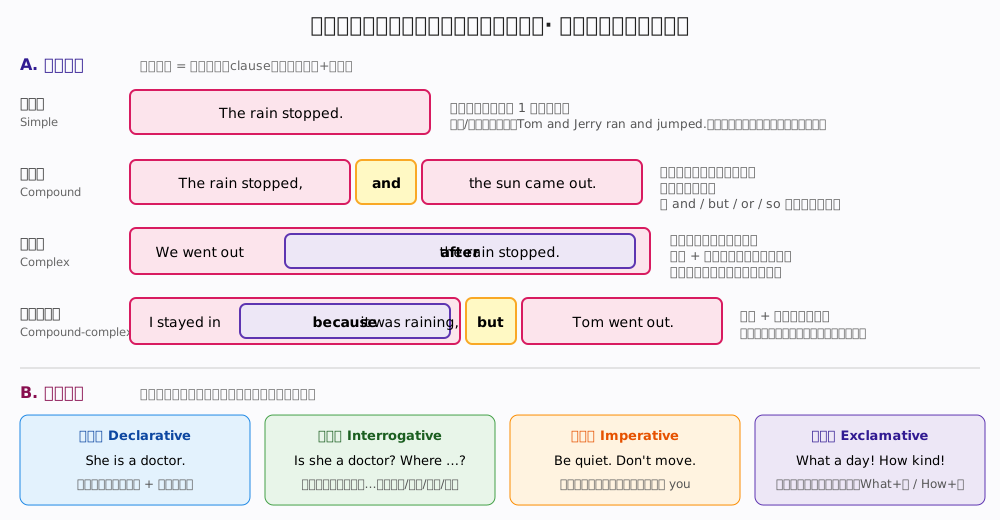
先明确两个分类维度,避免混淆:
- 按结构(第 6 章详述):简单句 / 并列句 / 复合句(主从复合句,学术称 complex sentence)/ 并列复合句 —— 看有几个主谓结构、怎么连。
- 按功能(本章):陈述句 / 疑问句 / 祈使句 / 感叹句 —— 看说话人想做什么。
一个句子同时属于两个维度:Where did you go after the party ended?(聚会结束后你去了哪里?)是“复合句 + 疑问句”。
2.2 陈述句 Declarative
Section titled “2.2 陈述句 Declarative”语序:主语 + 谓语 (+ 其他)。 肯定或否定地陈述一件事。
- 肯定:She speaks French.(她会说法语。)
- 否定:She does not speak French.(她不会说法语。)
| 情况 | 否定方法 | 例句 |
|---|---|---|
| 有 be / 助动词 / 情态动词 | 其后直接加 not | He is not here. I have not finished. You must not go.(他不在这里。我还没有做完。你不准走。) |
| 只有实义动词(一般现在/过去) | 加 do/does/did + not,动词还原 | She doesn’t like it. They didn’t come.(她不喜欢它。他们没有来。) |
| have 表“拥有” | 英式可 haven’t (got),美式 don’t have | I don’t have a car.(我没有车。) |
🔑 记忆:有操作词,not 跟其后;没有操作词,借 do 来。all / both / every / always + not = “不全”,不是全否。think / believe / suppose 的否定前移到主句,中文翻译放回从句。
其他否定手段
- 否定词:never, no, nobody, nothing, none, neither, nowhere, hardly, seldom, rarely, few, little
- I have never seen him. Nobody came. There is little hope.(我从未见过他。没有人来。几乎没有希望。)
- 部分否定:all / both / every / always + not = “并非都”:Not all birds can fly.(并非所有的鸟都会飞。) / Both of them are not here. 有歧义:表全部否定说 Neither of them is here.(他们俩都不在。),表部分否定说 Only one of them is here.(他们俩只有一个在。)
- 全部否定:none / neither / no / never:None of them came.(他们一个都没来。)
- 否定转移:I don’t think he is right.(英语习惯把否定放在 think / believe / suppose / expect 上,意思是“我认为他不对”)
- 双重否定表肯定:It’s not uncommon. = 并不少见(≈ fairly common)
英语里一个分句通常只有一个否定词:I didn’t see nobody. ✗ → I didn’t see anybody.(我没有看见任何人。) / I saw nobody.(我谁也没看见。)
2.3 疑问句 Interrogative
Section titled “2.3 疑问句 Interrogative”一般疑问句(Yes/No question)
Section titled “一般疑问句(Yes/No question)”语序:助动词/be/情态动词 + 主语 + 其余。 用 yes/no 回答。
- Are you ready? — Yes, I am. / No, I’m not.(你准备好了吗?—— 是的,准备好了。/ 不,还没有。)
- Do you like tea? — Yes, I do.(你喜欢茶吗?—— 是的,喜欢。)
- Can she swim? — No, she can’t.(她会游泳吗?—— 不,她不会。)
- Has he left? — Yes, he has.(他走了吗?—— 是的,走了。)
规则:把陈述句里的“操作词”(be / 助动词 / 情态动词)提到主语前;没有操作词就借 do/does/did。
特殊疑问句(Wh- question)
Section titled “特殊疑问句(Wh- question)”语序:疑问词 + 操作词(be / 助动词 / 情态动词)+ 主语 + 其余。 用具体信息回答。
| 疑问词 | 问 | 例句 |
|---|---|---|
| what | 什么 | What do you want?(你想要什么?) |
| which | 哪一个(有限范围) | Which one do you prefer?(你更喜欢哪一个?) |
| who / whom | 谁(主格 / 宾格) | Who called? Whom did you call?(谁打来的电话?你给谁打了电话?)(口语中 whom 常用 who 代替) |
| whose | 谁的 | Whose bag is this?(这是谁的包?) |
| when / where / why | 何时 / 何地 / 为何 | Why did she leave?(她为什么离开了?) |
| how | 如何 | How does it work?(它是怎么运作的?) |
| how + adj/adv | 多(大 / 远 / 常 / 少) | How old is she?(她多大?) 另有 how far / how often / how much / how many |
疑问词做主语时不倒装:Who broke the window?(谁打破了窗户?)(不是 Who did break)。What happened?(发生了什么事?)
Would you like tea or coffee? — Tea, please.(你想喝茶还是咖啡?—— 请给我茶。)(不能用 yes/no 回答)
反意疑问句(Tag question)
Section titled “反意疑问句(Tag question)”陈述 + 逗号 + 简短疑问,前肯后否、前否后肯。
- You are a student, aren’t you?(你是学生,不是吗?)
- She can’t drive, can she?(她不会开车,是吗?)
- He went home, didn’t he?(他回家了,不是吗?)
特殊情况:
| 前句 | 后半 | 例 |
|---|---|---|
| I am | aren’t I | I’m late, aren’t I?(我迟到了,是吧?) |
| Let’s | shall we | Let’s go, shall we?(我们走吧,好吗?) |
| 祈使句 | will you / won’t you | Open the door, will you?(把门打开,好吗?) |
| 含 never / seldom / hardly / little / few(视为否定) | 用肯定 | He seldom smokes, does he?(他很少抽烟,是吧?) |
| there be | there | There is a bank nearby, isn’t there?(附近有一家银行,不是吗?) |
| 主语 everyone / nobody 等 | they | Everyone is here, aren’t they?(大家都到了,不是吗?) |
| I think + 从句 | 随从句 | I think he is right, isn’t he?(我认为他是对的,不是吗?) |
🔑 记忆:尾巴口诀——I am → aren’t I;Let’s → shall we;祈使 → will you;there → there;never / seldom / hardly 算否定,尾巴用肯定;答句只看事实。
回答反意疑问句:只看事实。You don’t like it, do you?(你不喜欢它,是吗?) — 事实上喜欢:Yes, I do. 不喜欢:No, I don’t.(中文“是的,我不喜欢”在英语里是 No, I don’t.)
疑问句嵌入另一句时,恢复陈述语序,一般疑问加 if/whether:
- Where does he live?(他住在哪里?) → Do you know where he lives?(你知道他住在哪里吗?)
- Is she coming?(她会来吗?) → I wonder if she is coming.(我想知道她是否会来。)
2.4 祈使句 Imperative
Section titled “2.4 祈使句 Imperative”动词原形开头,主语 you 通常省略。 表命令、请求、建议、警告。
- 肯定:Sit down. Be careful. Please wait here.(坐下。小心。请在这里等。)
- 否定:Don’t move. Never give up.(别动。永不放弃。)
- 强调/带主语:Do come in. You stay here. Somebody help me!(一定要进来。你留在这里。来个人帮帮我!)
- 第一人称:Let’s go.(我们走吧。) / Let me try.(让我试试。)(否定 Let’s not go. 我们别去了。)
- 祈使句 + and/or + 陈述句 = 条件:Work hard, and you’ll succeed.(努力工作,你就会成功。)(如果…就)(形式上是并列句,第 6 章再讲;这里只看祈使句的用法)Hurry up, or you’ll be late.(快点,否则你会迟到。)(否则)
2.5 感叹句 Exclamative
Section titled “2.5 感叹句 Exclamative”| 结构 | 例句 |
|---|---|
| What (a/an) + 形容词 + 名词 (+ 主 + 谓)! | What a beautiful day (it is)!(多么美好的一天!) What lovely flowers!(多么可爱的花!) What terrible weather!(多么糟糕的天气!) |
| How + 形容词/副词 (+ 主 + 谓)! | How kind (you are)!(你多么善良!) How fast he runs!(他跑得多快!) |
判断:感叹的中心是名词用 what,是形容词/副词用 how。 What a tall boy he is!(他是个多高的男孩啊!)(中心是 boy)/ How tall he is!(他多高啊!)(中心是 tall)
2.6 there be 存在句
Section titled “2.6 there be 存在句”There + be + 主语 (+ 地点/时间),表示“某处有某物”。there 是形式主语,真正主语在 be 之后,be 与其一致。
- There is a book on the desk.(桌子上有一本书。) / There are two books.(有两本书。)
- There is a pen and two books.(有一支钢笔和两本书。)(就近原则)
- 时态与情态:There was a fire. There will be a meeting. There must be a mistake. There used to be a church here.(发生了一场火灾。将有一次会议。一定是弄错了。这里曾经有一座教堂。)
- 疑问与否定:Is there …? There isn’t … / There is no …
- 非谓语形式:I don’t want there to be any trouble.(我不希望出任何麻烦。)
have vs there be:have 表“拥有”,there be 表“存在”,二者都对:There are 30 students in our class. = Our class has 30 students.(我们班有 30 名学生。)中文“有”兼表两义,注意不要混成 ✗ There have 30 students。
🔑 记忆:there be = 某处存在;have = 某人拥有;There have 永远错。
2.7 强调与倒装(简单句层面的变形)
Section titled “2.7 强调与倒装(简单句层面的变形)”这两种变形在第 7 章有专门图解与详述(7.5、7.6),此处只列结构:
- 强调句:It is/was + 被强调部分 + that/who + 其余:It was in 2010 that we met.(我们正是在 2010 年相识的。)
- do 强调:I do hope you’ll come.(我真的希望你能来。)
- 完全倒装:Here comes the bus. There goes the bell.(公交车来了。铃响了。)
- 部分倒装:Never have I seen such a thing. Only then did I understand.(我从未见过这样的事。直到那时我才明白。)
🔑 记忆:完全倒装 = 整个谓语搬到主语前(Here comes the bus);部分倒装 = 只把操作词搬到主语前(Never have I seen…)。
2.8 句子的省略与并列
Section titled “2.8 句子的省略与并列”- 省略(ellipsis):避免重复时可省略相同部分。Tom likes tea and Mary (likes) coffee.(汤姆喜欢茶,玛丽喜欢咖啡。) / — Are you coming? — (I) Hope so.(—— 你来吗?—— 希望如此。)
- 简单句的并列成分:主语并列、谓语并列、宾语并列都不改变“简单句”身份:Tom and Jerry ran and jumped.(汤姆和杰瑞又跑又跳。) 仍是一个简单句,因为只有一个主谓结构(并列主语 + 并列谓语)。只有当两个完整分句连接时才成为并列句。
🔑 记忆:数完整的主谓结构——只有一组就是简单句;主语、谓语、宾语的并列不增加分句数。
2.9 易错点
Section titled “2.9 易错点”| 错误 | 正确 | 原因 |
|---|---|---|
| Do you know where does he live? | Do you know where he lives?(你知道他住在哪里吗?) | 间接疑问用陈述语序 |
| Who did break the window? | Who broke the window?(谁打破了窗户?) | 疑问词做主语不倒装 |
| What a beautiful the weather! | What beautiful weather!(多好的天气!) | weather 不可数,无 a |
| There have many people. | There are many people.(有很多人。) | 存在句用 there be |
| Don’t be late, do you? | Don’t be late, will you?(别迟到,好吗?) | 祈使句反问用 will you |
| I didn’t see nothing. | I didn’t see anything.(我什么都没看见。) | 避免双重否定 |
| — You don’t like it? — Yes, I don’t. | No, I don’t.(不,我不喜欢。) | 回答看事实,yes/no 与后半一致 |
2.10 速查表
Section titled “2.10 速查表”陈述 S + V … 否定:操作词 + not;无操作词借 do一般疑问 操作词 + S + V …? 答 yes/no特殊疑问 Wh- + 操作词 + S + V …? 疑问词做主语时不倒装选择疑问 … A or B? 不能答 yes/no反意疑问 陈述, 操作词(+n't) + 代词? 前肯后否、前否后肯;答句看事实祈使 (Don't) V原形 … Let's / Do V / 主语 you 可保留感叹 What (a) adj n! / How adj! 中心是名词用 what,是形/副用 how存在 There be + 真主语 + 地点 be 与后面的名词一致(就近)