第 3 章 · 词类与短语
一句话:十种词类是砖块,五种短语是砖块的组合;词类是“身份”,成分是“职务”。
3.1 一张图看懂
Section titled “3.1 一张图看懂”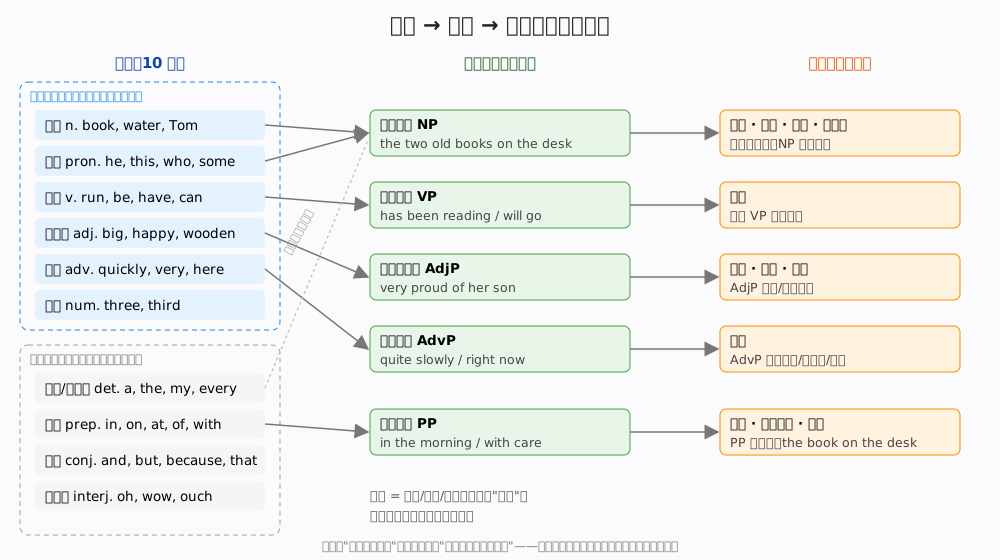
3.2 名词 Noun
Section titled “3.2 名词 Noun”名词├─ 专有名词 Proper:China, Tom, Monday, the Nile(首字母大写)└─ 普通名词 Common ├─ 可数 Countable │ ├─ 个体名词:book, apple, student │ └─ 集体名词:family, team, class, government(police, people, cattle 恒为复数,见下) └─ 不可数 Uncountable ├─ 物质名词:water, rice, paper, money, furniture └─ 抽象名词:love, advice, information, news, progress中国学习者常误当可数的不可数名词:advice, information, news, furniture, equipment, luggage/baggage, homework, knowledge, progress, weather, traffic, bread, paper(纸), work(工作)。 表数量用单位词:a piece of advice, two pieces of furniture, a loaf of bread, a cup of tea(完整的单位词表和数量限定词表见 3.10)。
可数/不可数两用(意义不同):a paper(报纸/论文) vs paper(纸);a glass(玻璃杯) vs glass(玻璃);a chicken(一只鸡) vs chicken(鸡肉);a work / works(作品;a works 工厂) vs work(工作)。
🔑 记忆:英语“数不数”看词不看物——一条建议在英语里是不可数的 advice,要说 a piece of advice。判断法:能不能说 one X, two Xs?能 → 可数。
| 规则 | 例 |
|---|---|
| 一般 +s | book → books |
| 以 s, x, ch, sh 结尾 +es | bus → buses, box → boxes, watch → watches |
| 辅音 + y → ies | city → cities(元音 + y 直接 +s:boy → boys) |
| 以 o 结尾 | 加 es:hero → heroes, potato → potatoes, tomato → tomatoes, echo → echoes;元音 + o、缩略词、外来词加 s:photo → photos, piano → pianos, radio → radios, zoo → zoos, video → videos;volcano(e)s, zero(e)s 两可 |
| f / fe → ves | leaf → leaves, knife → knives, wife → wives(但 roof → roofs, belief → beliefs, chief → chiefs) |
| 不规则 | man → men, woman → women, child → children, foot → feet, tooth → teeth, mouse → mice, ox → oxen |
| 单复同形 | sheep, deer, fish(鱼的种类可 fishes), Chinese, Japanese, means, series, species |
| 外来复数 | datum → data, criterion → criteria, phenomenon → phenomena, analysis → analyses |
| 复合名词 | passer-by → passers-by, son-in-law → sons-in-law;man/woman 开头两者都变:men teachers |
🔑 记忆:-o 加 es 的常用词:“英雄爱吃土豆西红柿”(heroes, potatoes, tomatoes)。f/fe → ves 的常用词口诀:“妻子拿刀去宰狼,小偷吓得发了慌,躲在架后保己命,半片树叶遮目光”(wife, knife, wolf, thief, shelf, self, half, leaf, life)。
名词的格:所有格
Section titled “名词的格:所有格”- ‘s 所有格(有生命):Tom’s book, the children’s room, James’s / James’ car,复数以 s 结尾只加 ‘:the students’ books
- of 所有格(无生命或长名词短语):the legs of the table, the title of the book I bought yesterday
- 双重所有格:a friend of my father’s, a photo of Tom’s(Tom 的照片,Tom 所拥有的)vs a photo of Tom(拍的是 Tom)
- 表时间/距离/国家等也用 ’s:today’s newspaper, an hour’s walk, China’s development
🔑 记忆:有生命 ’s,无生命 of,两者叠加 = 双重所有格(a friend of mine)。
集体名词的数
Section titled “集体名词的数”- 视为整体 → 单数;强调成员 → 复数(英式更常见):My family is big.(我家是个大家庭。) / My family are all doctors.(我家人都是医生。)
- 恒为复数:police, people, cattle:The police are coming.(警察来了。)
- 形似集合、实为不可数,恒用单数:furniture, machinery, equipment
3.3 代词 Pronoun
Section titled “3.3 代词 Pronoun”| 类别 | 成员 | 要点 |
|---|---|---|
| 人称代词 | 主格 I you he she it we they;宾格 me you him her it us them | 主格做主语;宾格做宾语和介词后(between you and me);口语 It’s me(是我。) |
| 物主代词 | 形容词性 my your his her its our their;名词性 mine yours his hers ours theirs(its 不独立使用) | 形容词性后必须接名词;名词性独立使用:This book is mine.(这本书是我的。) |
| 反身代词 | myself yourself himself herself itself ourselves yourselves themselves | 主宾同一人时:He hurt himself(他伤了自己。);强调:I did it myself(这是我自己做的。);固定搭配 enjoy oneself, help oneself, by oneself |
| 指示代词 | this that these those | this/these 近、that/those 远;that/those 可替代前面提到的名词避免重复:The climate here is like that of Hainan.(这里的气候像海南的气候。) |
| 疑问代词 | who whom whose what which | 见 2.3 |
| 关系代词 | who whom whose which that | 见 6.4 |
| 不定代词 | some any no every + one/body/thing;each, either, neither, both, all, none, other, another, many, much, few, little | 见下表 |
| 相互代词 | each other, one another | They love each other.(他们彼此相爱。) |
不定代词要点
Section titled “不定代词要点”| 组 | 用法 |
|---|---|
| some / any | some 用于肯定句和期待肯定回答的问句:Would you like some tea?(你想喝点茶吗?);any 用于否定、疑问、条件句;any 在肯定句中表“任何”:Any student can join.(任何学生都可以参加。) |
| each / every | each 强调个体(可做代词:Each of them);every 强调整体(只做限定词:every student) |
| both / either / neither | 用于两者:both 两者都,either 两者中任一,neither 两者都不 |
| all / any / none | 用于三者及以上 |
| other / another / the other / others / the others | other + 复数名词(其他的);another 再一个 / 另一个(不特指,通常三者以上);the other 两者中的另一个;others 泛指其他一些人/物;the others 特指其余全部 |
| few / a few / little / a little | few、little 否定含义(几乎没有);a few、a little 肯定含义(有一些);few/a few 修饰可数,little/a little 修饰不可数 |
| many / much / a lot of | many + 可数复数;much + 不可数;a lot of / lots of 两者皆可 |
复合不定代词(something, anyone, nobody…)作单数,被形容词修饰时形容词后置:something important, nothing new。
🔑 记忆:few / little——“有 a 则有,无 a 则无;few 数 little 量”。some / any——“肯定 some,否疑 any;请求邀请仍用 some”。other 系列——“the 定范围,s 表复数”:another(再一个)/ the other(两者中另一个)/ others(其他一些)/ the others(其余全部)。
it 的特殊用法
Section titled “it 的特殊用法”- 指代无生命事物、动物、婴儿(性别不明时)、前文提到的情况
- 天气、时间、距离:It’s raining. It’s 5 o’clock. It’s 3 miles to the town.(在下雨。现在五点了。到镇上有三英里。)
- 形式主语:It is important to learn English.(学英语很重要。) / It is a pity that he failed.(他失败了,真可惜。)
- 形式宾语:I find it hard to understand him.(我觉得很难理解他。) / We think it our duty to help.(我们认为帮忙是我们的责任。)
- 强调句:It was Tom who called.(打电话的是汤姆。)(见 7.5)
3.4 冠词与限定词 Article & Determiner
Section titled “3.4 冠词与限定词 Article & Determiner”限定词放在名词短语最前面,“框定”名词的范围。冠词是最常用的限定词。
限定词的排列顺序
Section titled “限定词的排列顺序”前位限定词 中位限定词 后位限定词 形容词 名词all / both / half the / a / my / this two / next / many old men ↓ ↓ ↓"all the three old men" "both my hands" "half an hour" "the next three days"中位限定词(冠词、指示词、物主词、some/any/no/every)互相排斥,一个名词短语只能有一个:a my friend ✗ → a friend of mine ✓。
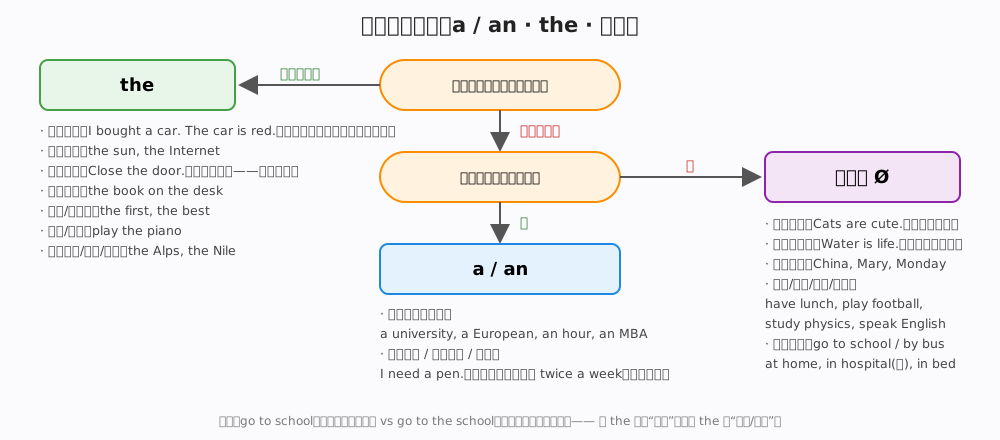
| 用 the | 用 a/an | 零冠词 |
|---|---|---|
| 特指、双方都知道 | 首次提及的可数单数 | 复数或不可数的泛指 |
| 独一无二:the sun, the world | “任何一个”:A dog is loyal.(狗是忠诚的。) | 专有名词、语言、学科 |
| 序数词/最高级/only:the first, the best, the only | “每一”:twice a week | 三餐、球类、棋类:have breakfast, play chess |
| 乐器:play the piano | 某一类中的一个:He is a teacher.(他是一名教师。) | 节日、月份、星期:on Monday, in May |
| 姓氏复数:the Smiths | 表数量:a hundred, a dozen | 抽象概念:Life is short.(人生短暂。) |
| 江河、山脉、群岛:the Yangtze, the Alps | 固定搭配:at home, by bus, in fact | |
| 形容词表一类人:the rich, the old | 头衔 + 名字:President Lincoln |
a vs an 看发音:a university(/juː/),an hour(/aʊə/),an MBA(/em/),a European。
🔑 记忆:冠词三步——特指?→ the;可数单数泛指?→ a/an;复数或不可数泛指 → 零冠词。 中位限定词(the / a / my / this / some)互斥,一个名词前只能有一个。
3.5 形容词 Adjective
Section titled “3.5 形容词 Adjective”- 前置定语:a beautiful garden
- 表语:The garden is beautiful.(这个花园很美。)
- 宾补:It made me happy.(这让我很开心。)
- 后置定语:修饰复合不定代词时(something interesting);某些形容词固定后置(the people present, the only way possible);形容词短语后置(a man proud of his son)
主要做表语的形容词(a- 开头等)
Section titled “主要做表语的形容词(a- 开头等)”afraid, alive, alone, asleep, awake, aware, ill, well, glad, content, sorry The baby is asleep.(宝宝睡着了。) ✓ / an asleep baby ✗ → a sleeping baby (ill, sorry, content 作定语时意义不同:ill health 不佳的健康,a sorry sight 可怜的景象)
只能做定语的形容词
Section titled “只能做定语的形容词”elder, former, latter, main, mere, only, sheer, utter, live(活的:a live fish;表语用 alive), daily, chief
多个形容词的排序
Section titled “多个形容词的排序”观点 → 大小 → 性质 → 形状 → 年龄 → 颜色 → 来源 → 材料 → 用途 + 名词(Cambridge Grammar 的顺序)
a lovely little round old red Chinese wooden dining table(实际中很少超过三个)
🔑 记忆:越主观的越靠前,越客观、越“本质”的越靠近名词——观点最主观放最前,材料和用途是事物本身属性放最后。
比较级与最高级
Section titled “比较级与最高级”| 构成 | 原级 | 比较级 | 最高级 |
|---|---|---|---|
| 单音节 +er/est | tall | taller | tallest |
| 以 e 结尾 +r/st | large | larger | largest |
| 重读闭音节,末尾单辅音双写 | big, hot | bigger, hotter | biggest, hottest |
| 辅音 + y → ier/iest | happy, early | happier | happiest |
| 多音节(及多数双音节)more/most | careful, interesting | more careful | most careful |
部分双音节形容词两种形式皆可:clever, narrow, simple, quiet, gentle(cleverer / more clever)。
不规则:good/well → better → best;bad/ill → worse → worst;many/much → more → most;little → less → least;far → farther/further → farthest/furthest;old → older/elder → oldest/eldest(elder/eldest 只用于家庭成员且只作定语)。
🔑 记忆:单音节 -er / -est,双音节看结尾(-y 变 -ier),多音节 more / most;不规则的就是最常用的那几个:好坏多少远老。
比较结构(详见 7.3):A is taller than B.(A 比 B 高。) / A is as tall as B.(A 和 B 一样高。) / A is the tallest of the three.(A 是三者中最高的。) / The more you read, the more you learn.(你读得越多,学到的就越多。)
-ing 与 -ed 形容词
Section titled “-ing 与 -ed 形容词”boring(令人无聊的,描述事物特性)vs bored(感到无聊的,描述人的感受):The film is boring, so I am bored.(这部电影很无聊,所以我感到很无聊。) 同类:interesting/interested, exciting/excited, surprising/surprised, tiring/tired, confusing/confused。
3.6 副词 Adverb
Section titled “3.6 副词 Adverb”| 类别 | 例词 | 位置倾向 |
|---|---|---|
| 方式 | slowly, well, hard, carefully | 动词后 / 宾语后 |
| 时间 | now, then, yesterday, soon, already, still, yet | 句末或句首 |
| 频率 | always, usually, often, sometimes, seldom, never | 实义动词前,be/助动词后 |
| 地点 | here, there, abroad, upstairs, everywhere | 句末 |
| 程度 | very, quite, too, so, enough, almost, rather, fairly | 被修饰词前(enough 在形容词/副词后) |
| 疑问 | when, where, why, how | 句首 |
| 关系 | when, where, why | 引导定语从句 |
| 连接(句副词) | however, therefore, moreover, otherwise | 句首加逗号,不是连词,不能直接连接两个分句 |
- 多个状语顺序:方式 → 地点 → 时间:He worked hard at home yesterday.(他昨天在家努力工作。);地点由小到大,时间由小到大。
- 两种形式的副词(意义不同):hard(努力地)vs hardly(几乎不);late(迟)vs lately(最近);high(高)vs highly(高度地);most(最)vs mostly(主要地)。
- very 修饰形容词/副词原级;much 修饰比较级(much better);修饰动词多用 very much:Thank you very much.(非常感谢你。)
- too … to 太…而不能;enough to 足够…能;so … that 如此…以至于。
- already / yet / still:already 肯定“已经”;yet 否定/疑问“还(没)”;still 肯定“仍然”(否定时放在助动词前:He still hasn’t come. 他仍然没来。)。
- ago vs before:ago 从现在往前算,配一般过去时;before 从过去某点往前算,配过去完成时;before 单独用时也可配现在完成时:I’ve seen it before.(我以前见过。)
🔑 记忆:频率副词的位置——“实义动词前,be / 助动词后”(He often goes / He is often late)。多个状语——“方式、地点、时间,小的在前大的在后”。
3.7 动词 Verb(概览,详见第 4、5 章)
Section titled “3.7 动词 Verb(概览,详见第 4、5 章)”动词├─ 实义动词 Main verb(有具体意义)│ ├─ 及物 vt. / 不及物 vi.│ ├─ 系动词(连接主语和表语)│ └─ 动态动词 / 静态动词(静态动词一般不用进行时:know, like, belong, own, seem…)├─ 助动词 Auxiliary(帮助构成时态、语态、否定、疑问)│ ├─ be(进行、被动) have(完成) do(否定、疑问、强调)│ └─ 情态动词 Modal:can could may might must shall should will would (ought to, need, dare, used to)└─ 非谓语形式:to do / doing / done(第 5 章)动词的五种形式:原形 do — 第三人称单数 does — 过去式 did — 过去分词 done — 现在分词 doing。规则动词过去式/分词加 -ed;不规则动词需要记忆(见附录)。
短语动词(动词 + 副词/介词):
- 可分(动副):turn on the light = turn the light on;宾语为代词时必须放中间:turn it on(✗ turn on it)
- 不可分(动介):look after the baby, look for it(介词后直接跟宾语)
- 三词短语:look forward to, put up with, get along with
🔑 记忆:动副可分,代词居中(turn it on);动介不分,宾语在后(look for it)。
3.8 介词 Preposition
Section titled “3.8 介词 Preposition”介词后面必须跟名词性成分(名词、代词、动名词、从句),共同构成介词短语,做状语、后置定语、表语。
| at | on | in |
|---|---|---|
| 时刻、时点:at 6:00, at noon, at night, at the weekend(英) | 日、星期、特定日子:on Monday, on May 1st, on Christmas Day, on the weekend(美) | 月、季、年、世纪、上午/下午/晚上:in May, in 2020, in the morning |
其他:for + 时间段(for two years);since + 时间点(since 2010);during + 名词(during the meeting);by 到…为止(by Friday);until/till 直到(until Friday);in + 时间段 = …之后(in ten minutes);after + 时间点/段(after lunch);within 在…之内。
有 this / that / next / last / every / all 等词时不用介词:this morning, next week, every day。
- at 点(at the bus stop, at home);in 内部(in the room, in Beijing);on 表面接触(on the wall, on the floor)
- above / over 上方(over 有覆盖或正上方义);below / under 下方
- between 两者之间(多者之间一一对应的关系亦可:a treaty between France, Germany and Italy);among 三者以上的群体之中
- in front of 在…前面(外部);in the front of 在…前部(内部)
- across 横过(表面);through 穿过(内部);over 越过(上方)
- to / toward(s) / into / onto / out of / from / along / past:表方向和移动
🔑 记忆:at 点、on 面、in 内,时间地点同一理——时刻 at、日子 on、月年 in;车站 at、桌面 on、房间 in。for 时段、since 时点。
其他常用介词
Section titled “其他常用介词”- by:被动的施动者;方式(by bus, by hand);到…为止;在…旁边
- with:伴随、工具、具有;without 没有
- of:所属、内容、部分
- for:为了、对于、因为、持续
- about / on:关于(on 更学术:a book on grammar)
- like / as:像(like 比喻,as 表身份:work as a teacher)
- despite / in spite of:尽管(后接名词,不接句子)
- because of / due to / owing to / thanks to:因为(后接名词)
- 特殊疑问句和定语从句中介词可以放句末(口语)或提前(正式):What are you looking at?(你在看什么?) / At what are you looking?(你在看什么?);the house in which I live = the house (which) I live in
- 介词 + 关系代词时只能用 whom / which,不能用 that / who。
3.9 连词 Conjunction
Section titled “3.9 连词 Conjunction”| 类型 | 作用 | 成员 |
|---|---|---|
| 并列连词 | 连接平等的词、短语、分句 | and, but, or, so, for(因为), yet, nor;成对:both…and, either…or, neither…nor, not only…but also, not…but |
| 从属连词 | 引导从句(第 6 章) | 时间 when/while/before/after/until/since/as soon as;原因 because/since/as;条件 if/unless;让步 although/though/even if;目的 so that;结果 so…that;比较 than/as…as;方式 as if;名词性从句 that/whether/if |
要点
- 连接同一对分句时,从属连词与并列连词只能用一个:Although he is rich, but he is unhappy. ✗ → 去掉 although 或 but。中文“虽然…但是”“因为…所以”英语只能保留一个(because … so 同理)。
- 并列连词连接的成分形式要对称(平行结构):She likes reading, swimming, and to dance. ✗ → … and dancing.
- 句副词(however, therefore, besides)不是连词,不能用逗号直接连接两个分句:It was late, however we went on. ✗ → It was late; however, we went on.(天已经很晚了;然而,我们继续前行。) / It was late, but we went on.(天已经很晚了,但我们继续前行。)
- and 在祈使句后表条件(见 2.4);for 作连词表原因时只能放句中,不能句首。
🔑 记忆:“虽然但是留一个,因为所以留一个”;however / therefore 是副词——前面分号,后面逗号。
3.10 数词与数量表达(英语的“量词”)
Section titled “3.10 数词与数量表达(英语的“量词”)”- 基数词:one, two, … twenty-one, one hundred (and) one, a/one thousand, a million, a billion hundred/thousand/million 前有具体数字时不加 s:two hundred;表约数加 s + of:hundreds of people
- 序数词:first, second, third, fourth, fifth, eighth, ninth, twelfth, twentieth, twenty-first;前面通常加 the
- 分数:分子基数、分母序数,分子 >1 时分母加 s:one third, two thirds, three quarters, a half
- 小数、百分数:3.14 = three point one four;50% = fifty percent
- 倍数:twice as … as, three times the size of, three times as large as(three times larger than 口语可用,但有“3 倍还是 4 倍”的歧义,正式写作避免)
- 年代:in the 1990s;in his forties(四十多岁)
- 数词 + 名词做定语用单数加连字符:a ten-year-old boy, a five-minute walk
🔑 记忆:具体数字 + hundred / thousand / million 不加 s;约数 hundreds of 加 s 加 of。复合定语公式:“数词-单数名词-连字符”(a five-minute walk)。
英语有没有“量词”?
Section titled “英语有没有“量词”?”汉语数词和名词之间必须有量词:“三本书”“一杯茶”。英语没有这个词类,规则是:
- 可数名词:数词直接加名词,不需要任何“量词”:three books(三本书)、a dog(一条狗)、two cars(两辆车)。✗ three pieces of books。
- 不可数名词:不能直接加数词(✗ two waters,✗ an advice),必须借一个可数的单位名词 + of 来计数——这就是英语里最接近“量词”的东西,语法上叫单位词 / 部分词(partitive,Quirk 5.8)。
所以中国学习者要建立的习惯是:可数名词别加“量词”,不可数名词必须加“量词”。
单位词(partitive):a + 单位名词 + of + 不可数名词
Section titled “单位词(partitive):a + 单位名词 + of + 不可数名词”| 类型 | 单位词 | 例 |
|---|---|---|
| 通用“一份 / 一条 / 一件” | piece, bit, item, word | a piece of advice(一条建议)、a piece of furniture(一件家具)、an item of news(一条新闻)、a bit of luck(一点运气)、a word of warning(一句提醒) |
| 容器 | cup, glass, bottle, bowl, box, bag, can, jar, basket | a cup of tea(一杯茶)、two bottles of water(两瓶水)、a bowl of rice(一碗饭) |
| 形状 / 切分 | loaf, slice, bar, sheet, drop, grain, lump, piece | a loaf of bread(一条面包)、a slice of cake(一片蛋糕)、a bar of chocolate(一块巧克力)、a sheet of paper(一张纸)、a drop of rain(一滴雨)、a grain of rice(一粒米) |
| 计量单位 | kilo, litre, metre, pound, spoonful, handful | two kilos of apples(两公斤苹果)、a litre of milk(一升牛奶)、a spoonful of sugar(一勺糖) |
| 成双成对的物品(本身恒为复数) | a pair of | a pair of trousers(一条裤子)、a pair of glasses(一副眼镜)、a pair of scissors(一把剪刀)、a pair of shoes(一双鞋) |
| 群体(可数名词复数) | group, crowd, team, flock, herd, bunch, set | a crowd of people(一群人)、a flock of sheep(一群羊)、a herd of cattle(一群牛)、a bunch of flowers(一束花)、a set of tools(一套工具) |
| 抽象 | fit, burst, stroke | a fit of anger(一阵怒气)、a burst of laughter(一阵笑声)、a stroke of luck(一次好运) |
复数和谓语:单位名词变复数,不可数名词不变:two pieces of furniture(两件家具;✗ furnitures)。谓语与单位名词一致:A piece of furniture is missing.(少了一件家具。)/ Two pairs of shoes are under the bed.(床下有两双鞋。)/ A pair of glasses is on the desk.(桌上有一副眼镜。)
注意:同一个名词可数和不可数时意义不同,可数时直接计数:two coffees(口语:两杯咖啡)、three papers(三份报纸 / 论文)、two chickens(两只鸡,对比 two pieces of chicken 两块鸡肉)。
数量限定词:按“可数 / 不可数”选
Section titled “数量限定词:按“可数 / 不可数”选”| 意思 | 只配可数复数 | 只配不可数 | 两者都可 |
|---|---|---|---|
| 很多 | many, a great / good many, a (large) number of, numerous | much, a great deal of, a large amount of | a lot of, lots of, plenty of |
| 一些 | several, a few, a couple of | a little, a bit of | some, any, enough |
| 很少、几乎没有 | few | little | — |
| 更多 / 更少 | more, fewer | more, less | more |
| 最多 / 最少 | most, fewest | most, least | most |
| 全部 / 没有 | all, both(两者), none | all, no, none | all, no, none, most |
| 每一 / 任一(配单数可数) | each, every, either, neither, another, one | — | — |
- There are many books but little time.(书很多,时间很少。)
- A number of students were late.(有好些学生迟到了。)/ A great deal of money was wasted.(浪费了大量的钱。)
- Fewer people came this year, so we spent less money.(今年来的人少了,所以我们花的钱也少了。)
- 肯定句中 much / many 单用略显正式,口语多用 a lot of:I have a lot of work.(我有很多工作。);否定和疑问句中 much / many 很自然:I don’t have much time.(我没多少时间。)
🔑 记忆:可数名词别加“量词”,不可数名词必须加“量词”(a piece / cup / bottle of)。数量词看名词:many / few / a number of 管个数,much / little / a great deal of 管分量;a lot of / plenty of / some 两边通吃。fewer 跟个数,less 跟分量。
3.11 感叹词 Interjection
Section titled “3.11 感叹词 Interjection”游离于句法结构之外:Oh! Wow! Ouch! Well, … Hmm. 只需知道它们不参与成分分析。
3.12 五种短语与“中心词”
Section titled “3.12 五种短语与“中心词””| 短语 | 中心词 | 结构示例 | 常做成分 |
|---|---|---|---|
| 名词短语 NP | 名词 | (限定词) + (形容词) + 名词 + (后置修饰):the two books on the desk that I bought | 主语、宾语、表语、同位语 |
| 动词短语 VP | 动词 | (助动词) + 动词:has been reading, will go | 谓语 |
| 形容词短语 AdjP | 形容词 | (程度副词) + 形容词 + (补足成分):very proud of her | 定语、表语、宾补 |
| 副词短语 AdvP | 副词 | (程度副词) + 副词:quite slowly | 状语 |
| 介词短语 PP | 介词 | 介词 + 名词性成分:in the morning | 状语、后置定语、表语 |
分析长句时,先把每个短语“打包”成一个单位,句子结构立刻变简单: [The tall man in the black coat] [has been waiting] [in the hall] [since morning].(那个穿黑外套的高个子男人从早上起就一直在大厅里等着。) → S + V + A + A。
3.13 易错点
Section titled “3.13 易错点”| 错误 | 正确 | 原因 |
|---|---|---|
| an advice / many informations | a piece of advice / much information | 不可数名词 |
| He is more taller than me. | He is taller than me.(他比我高。) | 比较级不重复 |
| the most easiest | the easiest | 最高级不重复 |
| I have two hundreds books. | two hundred books | 具体数字 + hundred 不加 s |
| Although … but … | 只留一个 | 中式“虽然…但是” |
| She is interesting in music. | She is interested in music.(她对音乐感兴趣。) | -ed 描述人的感受 |
| This is my a friend. | This is a friend of mine.(这是我的一个朋友。) | 中位限定词互斥 |
| very like / very enjoy | like … very much | very 不修饰动词 |
| in the last Sunday | last Sunday | last/next/this 前不用介词 |
| turn on it | turn it on | 代词宾语放动副短语中间 |
| He is a very hard-working man, isn’t it? | …, isn’t he? | 反意疑问代词对应主语 |
3.14 速查表
Section titled “3.14 速查表”名词 可数/不可数 → 决定冠词和数量词;复数变化规则 + 不规则;'s 与 of 所有格代词 主格/宾格;形容词性/名词性物主;反身;不定代词 some/any, few/little, other/another限定词 前位(all/both) → 中位(the/a/my/this,互斥) → 后位(数词/next/many)冠词 特指 the / 单数泛指 a(an 看发音) / 复数与不可数泛指、专名 零冠词形容词 定语·表语·宾补;排序越主观越靠前;比较级 -er/more;最高级 -est/most;-ing 物 / -ed 人副词 方式·时间·频率·地点·程度;顺序 方式→地点→时间;频率副词位于实义动词前介词 时间 at 点 / on 日 / in 月年;地点 at 点 / on 面 / in 内;for 时段 since 时点连词 并列(and/but/or/so) 只能一个;从属引导从句;however 等是副词不是连词数词 hundred 不加 s;分数 分子基数 分母序数;倍数 twice as…as量词 英语无量词词类:可数直接数(three books);不可数借单位词(a piece/cup/pair of) many/few/a number of 管个数;much/little/a great deal of 管分量;a lot of/some 两可短语 NP/VP/AdjP/AdvP/PP,中心词决定短语类型,分析长句先打包短语