跳转到内容

第 13 章 · 三角関数

项目 内容
シラバス项目 11. 三角関数(数学Ⅱ):(1) 三角関数(① 一般角と弧度法 ② 三角関数とその基本的な性質 ③ 三角関数とそのグラフ)、(2) 加法定理(① 三角関数の加法定理 ② 加法定理の応用 ③ 三角関数の合成)
コース 只有コース2 考
国内书对应 国内书第 11 章(任意角、定义、诱导公式)、第 12 章(图像与性质)、第 13 章(三角恒等变换)
本章新内容的分量 少。公式国内基本都学过;要补的是三倍角、半角的日本写法、两直线的夹角,以及 EJU 的“限定范围”答法和换元誘導

三角函数的公式国内学得很全:两角和差、二倍角、辅助角、降幂,国内书第 11–13 章都讲过。EJU 多出来的不在公式,在用法:方程和不等式一律在 0≤θ<2π0 \le \theta < 2\pi 这样的范围里求具体的值,不写通解;合成以后要按 θ\theta 的范围求最值;还常用 t=sin⁡θ+cos⁡θt = \sin\theta + \cos\theta、t=cos⁡θt = \cos\theta 换元,把三角函数变成 2 次、3 次函数,再接微分。丢分主要丢在三处:2θ2\theta 的范围没有翻倍,换元后忘了 tt 的范围,一个 tt 对应几个 θ\theta 没数清。

シラバス小项目(日文原文) 国内书位置 相同 / 讲法不同 / 国内没有 本章哪节讲
(1) ① 一般角と弧度法 国内书第 11 章 11.2 节 相同,见国内书第 11 章 不展开;用语见 13.7 节
(1) ② 三角関数とその基本的な性質 国内书第 11 章 11.3–11.5 节 相同(日本不用“奇变偶不变”口诀,直接列公式),见国内书第 11 章 不展开
(1) ③ 三角関数とそのグラフ 国内书第 12 章;三角不等式在 12.2 节 图像相同;方程式・不等式讲法不同:EJU 限定 0≤θ<2π0 \le \theta < 2\pi 求具体解 13.2
(2) ① 三角関数の加法定理 国内书第 13 章 13.2 节 相同;日本还用它求2直線のなす角 13.3
(2) ② 加法定理の応用 国内书第 13 章 13.3、13.5 节 讲法不同 + 国内没有:半角公式写成平方形式;3倍角の公式国内不要求;积和・和积日本放在发展内容 13.3
(2) ③ 三角関数の合成 国内书第 13 章 13.4 节(辅助角公式) 相同(名称不同);EJU 必带 θ\theta 的范围,并且常和换元一起考 13.4、13.5

表里前三行在日本叫法不同、内容一样,记住几个说法就够了:

  • 角的终边叫動径(どうけい),起始边叫始線;终边相同的角写成 θ+360∘×n\theta + 360^\circ \times n(nn 是整数),国内写 α+k⋅360∘\alpha + k \cdot 360^\circ。
  • 日本的周期指正的周期里最小的那个,就是国内的“最小正周期”。题干「周期は Aπ\fbox{A}\pi である」填的就是它。
  • 图像的平移说「θ\theta 軸方向に π3\dfrac{\pi}{3} だけ平行移動」,横轴常写 θ\theta 轴。y=sin⁡θy = \sin\theta 的图像叫正弦曲線。
  • 第 6 章的三角比用角度制(0∘≤θ≤180∘0^\circ \le \theta \le 180^\circ);本章是数学Ⅱ,题目基本都用弧度制。

加法定理の応用到底包括什么,学习指导要领(2018 年告示)数学Ⅱ的原文是“三角関数の加法定理や2倍角の公式,三角関数の合成について理解すること”,只点名 2倍角和合成;学习指导要领解说把“三角関数の和を積に直すなどの公式”列为发展内容。半角、3倍角没有点名,都能由加法定理推出,各出版社教科书放在正文、例题还是练习,处理不同。EJU 的题都能用加法定理现推,不必为积和・和积专门背公式;3倍角推一次要几行,记住更省时间。

本章四个知识点的关系:加法定理是源头,推出 2倍角、3倍角和合成;合成和 2倍角又是换元的工具;最后几乎所有题都落在“限定范围的方程、不等式、最值”上。

本章知识点的关系:加法定理推出 2倍角、3倍角和合成,再到换元,最后落到限定范围的方程、不等式和微分积分

13.2 三角方程式・三角不等式(θ の範囲つき)

Section titled “13.2 三角方程式・三角不等式(θ の範囲つき)”

国内解三角方程和不等式,先在一个周期里找解,再写”+2kπ+ 2k\pi,k∈Zk \in \mathbf{Z}“的通解(国内书第 12 章 12.2 节)。EJU 不要通解:题目一定先给出 θ\theta 的范围,最常见的是 0≤θ<2π0 \le \theta < 2\pi,也有 0≤θ≤π0 \le \theta \le \pi、0≤θ≤π20 \le \theta \le \dfrac{\pi}{2},要求写出这个范围里的全部具体解。

解法分三步:

  1. 化成基本形:化成 sin⁡u=a\sin u = a、cos⁡u=a\cos u = a、tan⁡u=a\tan u = a,或者对应的不等式。uu 可能是 θ\theta,也可能是 2θ2\theta、θ+π3\theta + \dfrac{\pi}{3} 这样的式子。式子里同时有 sin⁡θ\sin\theta 和 cos⁡2θ\cos^2\theta 时,用 sin⁡2θ+cos⁡2θ=1\sin^2\theta + \cos^2\theta = 1 统一成一种函数,再按 2 次方程因式分解。
  2. 换算范围:由 θ\theta 的范围算出 uu 的范围。0≤θ<2π0 \le \theta < 2\pi 时,θ+π3\theta + \dfrac{\pi}{3} 的范围是 π3≤θ+π3<7π3\dfrac{\pi}{3} \le \theta + \dfrac{\pi}{3} < \dfrac{7\pi}{3},2θ2\theta 的范围是 0≤2θ<4π0 \le 2\theta < 4\pi(绕两圈)。
  3. 在单位圆或图像上读解:sin⁡u=a\sin u = a 看单位圆与横线 y=ay = a 的交点,cos⁡u=a\cos u = a 看与竖线 x=ax = a 的交点,tan⁡u=a\tan u = a 看过原点、斜率为 aa 的直线。只取落在第 2 步范围里的角,最后换回 θ\theta。

日本教科书把这一套叫「三角関数を含む方程式・不等式」,放在三角函数图像之后。

  • 题目给出 θ\theta 的范围,要求解 sin⁡θ=a\sin\theta = a、cos⁡θ=a\cos\theta = a、tan⁡θ=a\tan\theta = a:在单位圆上找交点,只写范围里的角。
  • 方程里的角是 2θ2\theta、θ+α\theta + \alpha 等:先换算这个整体的范围,再找解,最后换回 θ\theta。
  • 方程里同时有 sin⁡θ\sin\theta 和 cos⁡2θ\cos^2\theta(或 cos⁡θ\cos\theta 和 sin⁡2θ\sin^2\theta):统一成一种函数,当 2 次方程解,舍掉绝对值大于 1 的根。
  • 不等式 sin⁡θ>a\sin\theta > a、2sin⁡2θ+sin⁡θ−1>02\sin^2\theta + \sin\theta - 1 > 0 等:先解出 sin⁡θ\sin\theta 的范围,再在单位圆上读出 θ\theta 的范围。
  • 不等式里的角是 θ+α\theta + \alpha:整体换元后,解集可能被 2π2\pi 切成两段,要分开写。
  • 范围的端点要看清:0≤θ<2π0 \le \theta < 2\pi 含 0 不含 2π2\pi,解 cos⁡θ=1\cos\theta = 1 只有 θ=0\theta = 0 一个。
  • 角是 2θ2\theta 时,2θ2\theta 在 00 到 4π4\pi 之间绕两圈,解的个数通常翻倍。
  • 统一函数时选能消掉平方的那种:有 cos⁡2θ\cos^2\theta 和 sin⁡θ\sin\theta,就把 cos⁡2θ\cos^2\theta 换成 1−sin⁡2θ1 - \sin^2\theta。
  • 不等式的解集写成不等式,不写区间:「π6<θ<5π6\dfrac{\pi}{6} < \theta < \dfrac{5\pi}{6}」。两段时写「0≤θ≤π20 \le \theta \le \dfrac{\pi}{2},11π6≤θ<2π\dfrac{11\pi}{6} \le \theta < 2\pi」。
  • EJU 题干的说法:「0≦θ<2π0 \leqq \theta < 2\pi のとき,方程式……を解け」「……を満たす θ\theta の値の範囲は」「解は A\fbox{A} 個ある」。

结论:−1<a<1-1 < a < 1 时,sin⁡θ=a\sin\theta = a 在 0≤θ<2π0 \le \theta < 2\pi 里恰有两个解;a=±1a = \pm 1 时恰有一个;∣a∣>1|a| > 1 时没有。

sin⁡θ\sin\theta 是单位圆上点 P(cos⁡θ,sin⁡θ)P(\cos\theta, \sin\theta) 的纵坐标。0≤θ<2π0 \le \theta < 2\pi 时,PP 把单位圆不重不漏地走一圈。(关键一步:θ\theta 和单位圆上的点一一对应,所以数解的个数就是数交点的个数。)横线 y=ay = a 与单位圆:∣a∣<1|a| < 1 时交于两点,∣a∣=1|a| = 1 时相切于一点,∣a∣>1|a| > 1 时不相交。

余弦同理,看竖线 x=ax = a。正切 tan⁡θ=a\tan\theta = a:过原点、斜率为 aa 的直线与单位圆交于关于原点对称的两点,所以在 0≤θ<2π0 \le \theta < 2\pi 里恰有两个解,相差 π\pi。

角是 2θ2\theta 时:θ\theta 走过 0≤θ<2π0 \le \theta < 2\pi,u=2θu = 2\theta 走过 0≤u<4π0 \le u < 4\pi,即单位圆两圈。每一圈的解数按上面的结论数,所以 sin⁡2θ=a\sin 2\theta = a(∣a∣<1|a| < 1)有 4 个解。一般地,sin⁡nθ=a\sin n\theta = a(∣a∣<1|a| < 1)有 2n2n 个解。

例 1 (场景:基本方程在范围内求解)

問題 0≦θ<2π0 \leqq \theta < 2\pi のとき,方程式 2cos⁡θ+3=02\cos\theta + \sqrt{3} = 0 を解け。

解答 2cos⁡θ+3=02\cos\theta + \sqrt{3} = 0 より cos⁡θ=−32\cos\theta = -\dfrac{\sqrt{3}}{2} である。単位円と直線 x=−32x = -\dfrac{\sqrt{3}}{2} の交点は,第 22 象限と第 33 象限に 11 つずつあるから,求める解は θ=5π6\theta = \dfrac{5\pi}{6},7π6\dfrac{7\pi}{6} である。

中文翻译 题目:0≦θ<2π0 \leqq \theta < 2\pi 时,解方程 2cos⁡θ+3=02\cos\theta + \sqrt{3} = 0。解答:由 2cos⁡θ+3=02\cos\theta + \sqrt{3} = 0 得 cos⁡θ=−32\cos\theta = -\dfrac{\sqrt{3}}{2}。单位圆与直线 x=−32x = -\dfrac{\sqrt{3}}{2} 的交点在第二象限、第三象限各有一个,所以所求的解是 θ=5π6\theta = \dfrac{5\pi}{6},7π6\dfrac{7\pi}{6}。

解说 cos⁡θ=a\cos\theta = a 看竖线 x=ax = a 与单位圆的交点,sin⁡θ=a\sin\theta = a 看横线 y=ay = a。国内写通解 θ=5π6+2kπ\theta = \dfrac{5\pi}{6} + 2k\pi、7π6+2kπ\dfrac{7\pi}{6} + 2k\pi;EJU 只写所给范围里的具体值,范围是“小于 2π2\pi”,2π2\pi 和 00 是同一个动径,不能写进答案。

例 2 (场景:角是 2θ+α2\theta + \alpha 的形式)

問題 0≦θ<2π0 \leqq \theta < 2\pi のとき,方程式 sin⁡(2θ−π3)=32\sin\left(2\theta - \dfrac{\pi}{3}\right) = \dfrac{\sqrt{3}}{2} を解け。

解答 u=2θ−π3u = 2\theta - \dfrac{\pi}{3} とおく。0≦θ<2π0 \leqq \theta < 2\pi より 0≦2θ<4π0 \leqq 2\theta < 4\pi であるから,

−π3≦u<11π3.-\frac{\pi}{3} \leqq u < \frac{11\pi}{3}.

sin⁡u=32\sin u = \dfrac{\sqrt{3}}{2} を 11 周の範囲で解くと u=π3u = \dfrac{\pi}{3},2π3\dfrac{2\pi}{3} で,これらに 2π2\pi を加えた 7π3\dfrac{7\pi}{3},8π3\dfrac{8\pi}{3} も uu の範囲に含まれる(8π3<11π3\dfrac{8\pi}{3} < \dfrac{11\pi}{3})。さらに 2π2\pi を加えると範囲を超える。

θ=12(u+π3)\theta = \dfrac{1}{2}\left(u + \dfrac{\pi}{3}\right) より

θ=π3, π2, 4π3, 3π2.\theta = \frac{\pi}{3},\ \frac{\pi}{2},\ \frac{4\pi}{3},\ \frac{3\pi}{2}.

中文翻译 题目:0≦θ<2π0 \leqq \theta < 2\pi 时,解方程 sin⁡(2θ−π3)=32\sin\left(2\theta - \dfrac{\pi}{3}\right) = \dfrac{\sqrt{3}}{2}。解答:设 u=2θ−π3u = 2\theta - \dfrac{\pi}{3}。由 0≦θ<2π0 \leqq \theta < 2\pi 得 0≦2θ<4π0 \leqq 2\theta < 4\pi,所以 −π3≦u<11π3-\dfrac{\pi}{3} \leqq u < \dfrac{11\pi}{3}。在绕一周的范围内解 sin⁡u=32\sin u = \dfrac{\sqrt{3}}{2} 得 u=π3u = \dfrac{\pi}{3},2π3\dfrac{2\pi}{3},再加上 2π2\pi 得到的 7π3\dfrac{7\pi}{3},8π3\dfrac{8\pi}{3} 也在 uu 的范围里(8π3<11π3\dfrac{8\pi}{3} < \dfrac{11\pi}{3})。再加 2π2\pi 就超出范围。由 θ=12(u+π3)\theta = \dfrac{1}{2}\left(u + \dfrac{\pi}{3}\right) 得 θ=π3\theta = \dfrac{\pi}{3},π2\dfrac{\pi}{2},4π3\dfrac{4\pi}{3},3π2\dfrac{3\pi}{2}。

解说 容易卡在:只在 00 到 2π2\pi 里找 uu,漏掉 7π3\dfrac{7\pi}{3}、8π3\dfrac{8\pi}{3},只得到两个解。步骤固定为:先写 2θ2\theta 的范围(00 到 4π4\pi),再减 π3\dfrac{\pi}{3} 得 uu 的范围;找齐 uu 的解后,用 θ=12(u+π3)\theta = \dfrac{1}{2}\left(u + \dfrac{\pi}{3}\right) 换回 θ\theta。

例 3 (场景:统一成一种函数后解 2 次方程)

問題 0≦θ<2π0 \leqq \theta < 2\pi のとき,方程式 2cos⁡2θ+3sin⁡θ−3=02\cos^2\theta + 3\sin\theta - 3 = 0 を解け。

解答 cos⁡2θ=1−sin⁡2θ\cos^2\theta = 1 - \sin^2\theta より

2(1−sin⁡2θ)+3sin⁡θ−3=0,2sin⁡2θ−3sin⁡θ+1=0,2(1 - \sin^2\theta) + 3\sin\theta - 3 = 0, \quad 2\sin^2\theta - 3\sin\theta + 1 = 0, (2sin⁡θ−1)(sin⁡θ−1)=0.(2\sin\theta - 1)(\sin\theta - 1) = 0.

よって sin⁡θ=12\sin\theta = \dfrac{1}{2} または sin⁡θ=1\sin\theta = 1 である。sin⁡θ=12\sin\theta = \dfrac{1}{2} より θ=π6\theta = \dfrac{\pi}{6},5π6\dfrac{5\pi}{6};sin⁡θ=1\sin\theta = 1 より θ=π2\theta = \dfrac{\pi}{2} である。したがって θ=π6\theta = \dfrac{\pi}{6},π2\dfrac{\pi}{2},5π6\dfrac{5\pi}{6} である。

中文翻译 题目:0≦θ<2π0 \leqq \theta < 2\pi 时,解方程 2cos⁡2θ+3sin⁡θ−3=02\cos^2\theta + 3\sin\theta - 3 = 0。解答:由 cos⁡2θ=1−sin⁡2θ\cos^2\theta = 1 - \sin^2\theta,得 2(1−sin⁡2θ)+3sin⁡θ−3=02(1 - \sin^2\theta) + 3\sin\theta - 3 = 0,2sin⁡2θ−3sin⁡θ+1=02\sin^2\theta - 3\sin\theta + 1 = 0,(2sin⁡θ−1)(sin⁡θ−1)=0(2\sin\theta - 1)(\sin\theta - 1) = 0。所以 sin⁡θ=12\sin\theta = \dfrac{1}{2} 或 sin⁡θ=1\sin\theta = 1。由 sin⁡θ=12\sin\theta = \dfrac{1}{2} 得 θ=π6\theta = \dfrac{\pi}{6},5π6\dfrac{5\pi}{6};由 sin⁡θ=1\sin\theta = 1 得 θ=π2\theta = \dfrac{\pi}{2}。因此 θ=π6\theta = \dfrac{\pi}{6},π2\dfrac{\pi}{2},5π6\dfrac{5\pi}{6}。

解说 统一函数时选能消掉平方的那种:有 cos⁡2θ\cos^2\theta 和 sin⁡θ\sin\theta,就把 cos⁡2θ\cos^2\theta 换成 1−sin⁡2θ1 - \sin^2\theta。解出 sin⁡θ\sin\theta 后先对照 −1≦sin⁡θ≦1-1 \leqq \sin\theta \leqq 1,舍掉范围外的根;本题两个根都在范围内,各自都要解出 θ\theta。

例 4 (场景:不等式先解出 sin⁡θ\sin\theta 的范围)

問題 0≦θ<2π0 \leqq \theta < 2\pi のとき,不等式 2sin⁡2θ+sin⁡θ−1>02\sin^2\theta + \sin\theta - 1 > 0 を解け。

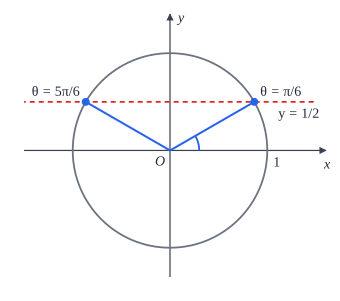
横线 y = 1/2 与单位圆交于 θ = π/6 和 θ = 5π/6 两点,单位圆上比这条线高的那段弧就是 sin θ > 1/2 的部分

解答 (2sin⁡θ−1)(sin⁡θ+1)>0(2\sin\theta - 1)(\sin\theta + 1) > 0 より sin⁡θ>12\sin\theta > \dfrac{1}{2} または sin⁡θ<−1\sin\theta < -1 である。

−1≦sin⁡θ≦1-1 \leqq \sin\theta \leqq 1 より,sin⁡θ<−1\sin\theta < -1 は成り立たない。よって sin⁡θ>12\sin\theta > \dfrac{1}{2} である。単位円上で yy 座標が 12\dfrac{1}{2} より大きい部分は,π6\dfrac{\pi}{6} と 5π6\dfrac{5\pi}{6} の間の弧であるから,

π6<θ<5π6.\frac{\pi}{6} < \theta < \frac{5\pi}{6}.

中文翻译 题目:0≦θ<2π0 \leqq \theta < 2\pi 时,解不等式 2sin⁡2θ+sin⁡θ−1>02\sin^2\theta + \sin\theta - 1 > 0。解答:由 (2sin⁡θ−1)(sin⁡θ+1)>0(2\sin\theta - 1)(\sin\theta + 1) > 0,得 sin⁡θ>12\sin\theta > \dfrac{1}{2} 或 sin⁡θ<−1\sin\theta < -1。因为 −1≦sin⁡θ≦1-1 \leqq \sin\theta \leqq 1,sin⁡θ<−1\sin\theta < -1 不成立。所以 sin⁡θ>12\sin\theta > \dfrac{1}{2}。单位圆上纵坐标大于 12\dfrac{1}{2} 的部分是 π6\dfrac{\pi}{6} 与 5π6\dfrac{5\pi}{6} 之间的弧,因此 π6<θ<5π6\dfrac{\pi}{6} < \theta < \dfrac{5\pi}{6}。

解说 容易卡在:把 sin⁡θ<−1\sin\theta < -1 也去解,或者忘了说明它不成立。∣sin⁡θ∣≦1|\sin\theta| \leqq 1,绝对值大于 1 的根本来就不可能是解,说明一句舍掉即可。解集用不等式写,不写成区间。

例 5 (场景:不等式里的角是 θ+α\theta + \alpha,解集被切成两段)

問題 0≦θ<2π0 \leqq \theta < 2\pi のとき,不等式 sin⁡(θ+π3)≧12\sin\left(\theta + \dfrac{\pi}{3}\right) \geqq \dfrac{1}{2} を解け。

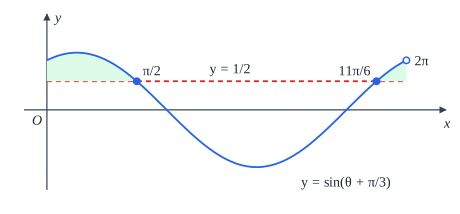
y = sin(θ + π/3) 在 θ 从 0 到 2π 的范围上,绿色两段是曲线不低于 y = 1/2 的部分:左边到 θ = π/2,右边从 θ = 11π/6 起

解答 u=θ+π3u = \theta + \dfrac{\pi}{3} とおくと,π3≦u<7π3\dfrac{\pi}{3} \leqq u < \dfrac{7\pi}{3} である。

sin⁡u≧12\sin u \geqq \dfrac{1}{2} を 11 周の範囲で解くと π6≦u≦5π6\dfrac{\pi}{6} \leqq u \leqq \dfrac{5\pi}{6},次の 11 周では 13π6≦u≦17π6\dfrac{13\pi}{6} \leqq u \leqq \dfrac{17\pi}{6} である。uu の範囲との共通部分をとると

π3≦u≦5π6または13π6≦u<7π3.\frac{\pi}{3} \leqq u \leqq \frac{5\pi}{6} \quad \text{または} \quad \frac{13\pi}{6} \leqq u < \frac{7\pi}{3}.

π3\dfrac{\pi}{3} を引いて

0≦θ≦π2,11π6≦θ<2π.0 \leqq \theta \leqq \frac{\pi}{2}, \qquad \frac{11\pi}{6} \leqq \theta < 2\pi.

中文翻译 题目:0≦θ<2π0 \leqq \theta < 2\pi 时,解不等式 sin⁡(θ+π3)≧12\sin\left(\theta + \dfrac{\pi}{3}\right) \geqq \dfrac{1}{2}。解答:设 u=θ+π3u = \theta + \dfrac{\pi}{3},则 π3≦u<7π3\dfrac{\pi}{3} \leqq u < \dfrac{7\pi}{3}。在绕一周的范围内解 sin⁡u≧12\sin u \geqq \dfrac{1}{2} 得 π6≦u≦5π6\dfrac{\pi}{6} \leqq u \leqq \dfrac{5\pi}{6},下一周是 13π6≦u≦17π6\dfrac{13\pi}{6} \leqq u \leqq \dfrac{17\pi}{6}。与 uu 的范围取公共部分:π3≦u≦5π6\dfrac{\pi}{3} \leqq u \leqq \dfrac{5\pi}{6} 或 13π6≦u<7π3\dfrac{13\pi}{6} \leqq u < \dfrac{7\pi}{3}。减去 π3\dfrac{\pi}{3}:0≦θ≦π20 \leqq \theta \leqq \dfrac{\pi}{2},11π6≦θ<2π\dfrac{11\pi}{6} \leqq \theta < 2\pi。

解说 另一种解法:直接画 y=sin⁡(θ+π3)y = \sin\left(\theta + \dfrac{\pi}{3}\right) 在 0≦θ<2π0 \leqq \theta < 2\pi 上的图像(上图),它是 y=sin⁡θy = \sin\theta 向左平移 π3\dfrac{\pi}{3}。先解方程 sin⁡(θ+π3)=12\sin\left(\theta + \dfrac{\pi}{3}\right) = \dfrac{1}{2} 得 θ=π2\theta = \dfrac{\pi}{2},11π6\dfrac{11\pi}{6},再看图上哪几段在横线上方。换元法步骤清楚、不依赖画图;画图法一眼看出解集分成两段,适合检查有没有漏掉一段。容易卡在:只写了 π3≦u≦5π6\dfrac{\pi}{3} \leqq u \leqq \dfrac{5\pi}{6} 一段,漏掉 uu 绕过 2π2\pi 之后的那一小段。

  • 在 0≤θ<2π0 \le \theta < 2\pi 里:sin⁡θ=a\sin\theta = a、cos⁡θ=a\cos\theta = a(∣a∣<1|a| < 1)各有 2 个解,a=±1a = \pm 1 时各 1 个;tan⁡θ=a\tan\theta = a 总有 2 个解,相差 π\pi。推导见本节“证明”。
  • sin⁡nθ=a\sin n\theta = a(∣a∣<1|a| < 1)在 0≤θ<2π0 \le \theta < 2\pi 里有 2n2n 个解。推导:nθn\theta 绕 nn 圈,每圈 2 个。
  • 同一个方程的两个解关于对称轴对称:sin⁡θ=a\sin\theta = a 的两个解之和是 π\pi(a>0a > 0)或 3π3\pi(a<0a < 0);cos⁡θ=a\cos\theta = a 的两个解之和是 2π2\pi。推导:单位圆关于 yy 轴、xx 轴对称。EJU 问“解的和”时可以直接用。
  • sin⁡θ≥a\sin\theta \ge a 的解集是单位圆上横线 y=ay = a 上方的一段弧,弧跨过 θ=0\theta = 0 时要拆成两段写。
  • 错在哪:解 sin⁡2θ=a\sin 2\theta = a 时,2θ2\theta 的范围仍按 0≤2θ<2π0 \le 2\theta < 2\pi 找解。 为什么错:θ<2π\theta < 2\pi 时 2θ<4π2\theta < 4\pi,绕了两圈,第二圈的解被丢掉了。 正确做法:设 u=2θu = 2\theta,先写”0≤u<4π0 \le u < 4\pi“,再在两圈里找解。
  • 错在哪:2 次方程解出 sin⁡θ=2\sin\theta = 2 或 cos⁡θ=−32\cos\theta = -\dfrac{3}{2},还去找对应的 θ\theta,或者当成“无解”把整题判成无解。 为什么错:∣sin⁡θ∣≤1|\sin\theta| \le 1,绝对值大于 1 的根本来就不是解,只把这个根舍掉,另一个根照样要解。 正确做法:解出 sin⁡θ\sin\theta 后先对照 −1≤sin⁡θ≤1-1 \le \sin\theta \le 1,舍掉范围外的根。
  • 错在哪:0≤θ<2π0 \le \theta < 2\pi 时把 θ=2π\theta = 2\pi 也写进答案。 为什么错:范围是“小于 2π2\pi”,2π2\pi 和 00 是同一个动径,已经算过一次。 正确做法:写答案前对照题目的范围逐个检查端点。
  • 错在哪:写出通解 θ=π6+2nπ\theta = \dfrac{\pi}{6} + 2n\pi。 为什么错:EJU 的空格只能填具体的数,题目要的是范围内的解。 正确做法:在题目给的范围里逐个列出。

θ\theta 从 0 增加到 2π2\pi,单位圆上的点 PP 逆时针走一圈。sin⁡θ=a\sin\theta = a 就是问”PP 走一圈,有几次高度恰好是 aa“:高度在 −1-1 和 11 之间的水平线,一圈里一定被穿过两次,上去一次、下来一次。2θ2\theta 相当于 PP 的速度加倍,同样的时间走两圈,穿过的次数也就翻倍。

不等式 sin⁡θ>a\sin\theta > a 是问”PP 在水平线上方的时间段”,就是单位圆在线上方的那段弧。

  • 前置:国内书第 12 章 12.2 节,用图像解三角不等式;第 11 章 11.3 节,单位圆定义。
  • 前置:本书第 5 章 2次関数,统一函数后是 2 次方程、2 次不等式。
  • 后续:13.4 节合成之后、13.5 节换元之后,最后一步都是本节的限定范围求解。
  • 常一起考:本书第 22、23 章,求两条三角曲线围成的面积时,先解本节的方程求交点。

13.3 加法定理の応用(2倍角・半角・3倍角,積和・和積,2直線のなす角)

Section titled “13.3 加法定理の応用(2倍角・半角・3倍角,積和・和積,2直線のなす角)”

加法定理(两角和差公式)国内书第 13 章 13.2 节讲过,日本叫加法定理(かほうていり):

sin⁡(α±β)=sin⁡αcos⁡β±cos⁡αsin⁡β,cos⁡(α±β)=cos⁡αcos⁡β∓sin⁡αsin⁡β,\sin(\alpha \pm \beta) = \sin\alpha\cos\beta \pm \cos\alpha\sin\beta,\qquad \cos(\alpha \pm \beta) = \cos\alpha\cos\beta \mp \sin\alpha\sin\beta, tan⁡(α±β)=tan⁡α±tan⁡β1∓tan⁡αtan⁡β.\tan(\alpha \pm \beta) = \frac{\tan\alpha \pm \tan\beta}{1 \mp \tan\alpha\tan\beta}.

由它推出的公式日本统称「加法定理の応用」。和国内比:

2倍角の公式:与国内相同。sin⁡2α=2sin⁡αcos⁡α\sin 2\alpha = 2\sin\alpha\cos\alpha,cos⁡2α=cos⁡2α−sin⁡2α=1−2sin⁡2α=2cos⁡2α−1\cos 2\alpha = \cos^2\alpha - \sin^2\alpha = 1 - 2\sin^2\alpha = 2\cos^2\alpha - 1,tan⁡2α=2tan⁡α1−tan⁡2α\tan 2\alpha = \dfrac{2\tan\alpha}{1 - \tan^2\alpha}。

半角の公式:日本教科书写成平方的形式,不带 ±\pm 根号:

sin⁡2α2=1−cos⁡α2,cos⁡2α2=1+cos⁡α2,tan⁡2α2=1−cos⁡α1+cos⁡α.\sin^2\frac{\alpha}{2} = \frac{1 - \cos\alpha}{2},\qquad \cos^2\frac{\alpha}{2} = \frac{1 + \cos\alpha}{2},\qquad \tan^2\frac{\alpha}{2} = \frac{1 - \cos\alpha}{1 + \cos\alpha}.

国内书第 13 章 13.5 节分成“降幂公式”(角是 α\alpha 和 2α2\alpha)和“半角公式”(开方带 ±\pm)两组,其实是同一组式子;日本只记这一组,开方时再按角的范围定符号。

3倍角の公式(国内不要求):

sin⁡3α=3sin⁡α−4sin⁡3α,cos⁡3α=4cos⁡3α−3cos⁡α.\sin 3\alpha = 3\sin\alpha - 4\sin^3\alpha,\qquad \cos 3\alpha = 4\cos^3\alpha - 3\cos\alpha.

sin⁡3α\sin 3\alpha 只用 sin⁡α\sin\alpha 表示,cos⁡3α\cos 3\alpha 只用 cos⁡α\cos\alpha 表示,所以一换元就是 3 次函数(13.5 节)。

積を和に直す公式・和を積に直す公式(国内“会推导、不要求记忆”,日本学习指导要领解说列为発展内容):

sin⁡αcos⁡β=12{sin⁡(α+β)+sin⁡(α−β)},sin⁡A+sin⁡B=2sin⁡A+B2cos⁡A−B2.\sin\alpha\cos\beta = \frac{1}{2}\{\sin(\alpha + \beta) + \sin(\alpha - \beta)\},\qquad \sin A + \sin B = 2\sin\frac{A + B}{2}\cos\frac{A - B}{2}.

其余几个(cos⁡αcos⁡β\cos\alpha\cos\beta、sin⁡αsin⁡β\sin\alpha\sin\beta、sin⁡A−sin⁡B\sin A - \sin B、cos⁡A±cos⁡B\cos A \pm \cos B)写法相同,见“常用推论”。

2直線のなす角:两条直线 y=m1x+n1y = m_1 x + n_1、y=m2x+n2y = m_2 x + n_2 与 xx 轴正方向的夹角分别是 α\alpha、β\beta,则 tan⁡α=m1\tan\alpha = m_1,tan⁡β=m2\tan\beta = m_2。两直线所成的角 θ\theta(0<θ≤π20 < \theta \le \dfrac{\pi}{2},日本说「2直線のなす角」)满足

tan⁡θ=∣m1−m21+m1m2∣(1+m1m2≠0).\tan\theta = \left|\frac{m_1 - m_2}{1 + m_1 m_2}\right| \quad (1 + m_1 m_2 \ne 0).

1+m1m2=01 + m_1 m_2 = 0 时两直线垂直,θ=π2\theta = \dfrac{\pi}{2}。

  • 已知 cos⁡α\cos\alpha 和 α\alpha 的范围,求 α2\dfrac{\alpha}{2} 的三角函数值:用半角公式求平方,再按 α2\dfrac{\alpha}{2} 的范围开方定符号。
  • 题目里出现 3θ3\theta(单位圆上的点转 θ\theta 和 3θ3\theta,或 sin⁡3θ\sin 3\theta、cos⁡3θ\cos 3\theta):用 3倍角公式化成 sin⁡θ\sin\theta 或 cos⁡θ\cos\theta 的 3 次式。
  • 角的和是 90∘90^\circ、180∘180^\circ 这样的特殊值(如 θ=18∘\theta = 18^\circ,2θ+3θ=90∘2\theta + 3\theta = 90^\circ):用 2倍角和 3倍角列方程求值。
  • 给出两条直线的方程(或斜率),求它们所成的角:用 2直線のなす角 的公式。
  • 两个三角函数的积或和,角又凑不成特殊角(如 sin⁡75∘cos⁡15∘\sin 75^\circ\cos 15^\circ):用积和・和积公式变成特殊角。
  • 半角公式求出的是平方,开方取正还是取负,看 α2\dfrac{\alpha}{2} 所在的象限,不看 α\alpha。
  • 3倍角公式两个式子系数的位置不同:sin⁡3α\sin 3\alpha 是“3 减 4”(3sin⁡α−4sin⁡3α3\sin\alpha - 4\sin^3\alpha),cos⁡3α\cos 3\alpha 是“4 减 3”(4cos⁡3α−3cos⁡α4\cos^3\alpha - 3\cos\alpha)。日本教科书有时写成 cos⁡3α=−3cos⁡α+4cos⁡3α\cos 3\alpha = -3\cos\alpha + 4\cos^3\alpha,是同一个式子。
  • 2直線のなす角 取的是锐角(或直角),所以公式带绝对值。题目问“钝角那一个”时用 π−θ\pi - \theta。
  • 积和・和积不熟时不要硬背,用加法定理两式相加或相减现推,两行就出来。
  • EJU 题干的说法:「2倍角の公式を用いると」「半角の公式により」「3倍角の公式」「2直線のなす角を θ\theta とすると (0<θ<π2)\left(0 < \theta < \dfrac{\pi}{2}\right)」。

半角公式:在 2倍角公式 cos⁡2x=1−2sin⁡2x=2cos⁡2x−1\cos 2x = 1 - 2\sin^2 x = 2\cos^2 x - 1 中令 x=α2x = \dfrac{\alpha}{2}(关键一步:2倍角公式对任意角成立,α2\dfrac{\alpha}{2} 的二倍就是 α\alpha),得 cos⁡α=1−2sin⁡2α2=2cos⁡2α2−1\cos\alpha = 1 - 2\sin^2\dfrac{\alpha}{2} = 2\cos^2\dfrac{\alpha}{2} - 1,移项即得前两式;两式相除得第三式。

3倍角公式:把 3α3\alpha 写成 2α+α2\alpha + \alpha,用加法定理,再用 2倍角公式(关键一步:每一项都化成只含 sin⁡α\sin\alpha,余弦的平方用 cos⁡2α=1−sin⁡2α\cos^2\alpha = 1 - \sin^2\alpha 消掉):

sin⁡3α=sin⁡2αcos⁡α+cos⁡2αsin⁡α=2sin⁡αcos⁡2α+(1−2sin⁡2α)sin⁡α=2sin⁡α(1−sin⁡2α)+sin⁡α−2sin⁡3α=3sin⁡α−4sin⁡3α.\begin{aligned} \sin 3\alpha &= \sin 2\alpha\cos\alpha + \cos 2\alpha\sin\alpha \\ &= 2\sin\alpha\cos^2\alpha + (1 - 2\sin^2\alpha)\sin\alpha \\ &= 2\sin\alpha(1 - \sin^2\alpha) + \sin\alpha - 2\sin^3\alpha = 3\sin\alpha - 4\sin^3\alpha. \end{aligned}

余弦同理,这次把 sin⁡2α\sin^2\alpha 换成 1−cos⁡2α1 - \cos^2\alpha:

cos⁡3α=cos⁡2αcos⁡α−sin⁡2αsin⁡α=(2cos⁡2α−1)cos⁡α−2sin⁡2αcos⁡α=2cos⁡3α−cos⁡α−2(1−cos⁡2α)cos⁡α=4cos⁡3α−3cos⁡α.\begin{aligned} \cos 3\alpha &= \cos 2\alpha\cos\alpha - \sin 2\alpha\sin\alpha \\ &= (2\cos^2\alpha - 1)\cos\alpha - 2\sin^2\alpha\cos\alpha \\ &= 2\cos^3\alpha - \cos\alpha - 2(1 - \cos^2\alpha)\cos\alpha = 4\cos^3\alpha - 3\cos\alpha. \end{aligned}

积和公式:把 sin⁡(α+β)=sin⁡αcos⁡β+cos⁡αsin⁡β\sin(\alpha + \beta) = \sin\alpha\cos\beta + \cos\alpha\sin\beta 和 sin⁡(α−β)=sin⁡αcos⁡β−cos⁡αsin⁡β\sin(\alpha - \beta) = \sin\alpha\cos\beta - \cos\alpha\sin\beta 相加,cos⁡αsin⁡β\cos\alpha\sin\beta 抵消,得 sin⁡(α+β)+sin⁡(α−β)=2sin⁡αcos⁡β\sin(\alpha + \beta) + \sin(\alpha - \beta) = 2\sin\alpha\cos\beta。

和积公式:在上式中令 A=α+βA = \alpha + \beta,B=α−βB = \alpha - \beta,则 α=A+B2\alpha = \dfrac{A + B}{2},β=A−B2\beta = \dfrac{A - B}{2},代入得 sin⁡A+sin⁡B=2sin⁡A+B2cos⁡A−B2\sin A + \sin B = 2\sin\dfrac{A + B}{2}\cos\dfrac{A - B}{2}。

2直線のなす角:两直线所成的角是 ∣α−β∣|\alpha - \beta| 或 π−∣α−β∣\pi - |\alpha - \beta|,两者的正切只差一个符号,所以所成锐角的正切等于 ∣tan⁡(α−β)∣|\tan(\alpha - \beta)|。由加法定理

tan⁡(α−β)=tan⁡α−tan⁡β1+tan⁡αtan⁡β=m1−m21+m1m2,\tan(\alpha - \beta) = \frac{\tan\alpha - \tan\beta}{1 + \tan\alpha\tan\beta} = \frac{m_1 - m_2}{1 + m_1 m_2},

取绝对值即得。

例 1 (场景:已知 cos⁡α\cos\alpha 求半角的值)

問題 π2<α<π\dfrac{\pi}{2} < \alpha < \pi,cos⁡α=−725\cos\alpha = -\dfrac{7}{25} とする。sin⁡α2\sin\dfrac{\alpha}{2},cos⁡α2\cos\dfrac{\alpha}{2},tan⁡α2\tan\dfrac{\alpha}{2} の値を求めよ。

解答 半角の公式より

sin⁡2α2=1−(−725)2=1625,cos⁡2α2=1+(−725)2=925.\sin^2\frac{\alpha}{2} = \frac{1 - \left(-\frac{7}{25}\right)}{2} = \frac{16}{25},\qquad \cos^2\frac{\alpha}{2} = \frac{1 + \left(-\frac{7}{25}\right)}{2} = \frac{9}{25}.

π4<α2<π2\dfrac{\pi}{4} < \dfrac{\alpha}{2} < \dfrac{\pi}{2} であるから,sin⁡α2>0\sin\dfrac{\alpha}{2} > 0,cos⁡α2>0\cos\dfrac{\alpha}{2} > 0 である。よって sin⁡α2=45\sin\dfrac{\alpha}{2} = \dfrac{4}{5},cos⁡α2=35\cos\dfrac{\alpha}{2} = \dfrac{3}{5},tan⁡α2=43\tan\dfrac{\alpha}{2} = \dfrac{4}{3} である。

中文翻译 题目:设 π2<α<π\dfrac{\pi}{2} < \alpha < \pi,cos⁡α=−725\cos\alpha = -\dfrac{7}{25}。求 sin⁡α2\sin\dfrac{\alpha}{2},cos⁡α2\cos\dfrac{\alpha}{2},tan⁡α2\tan\dfrac{\alpha}{2} 的值。解答:由半角公式,sin⁡2α2=1−(−725)2=1625\sin^2\dfrac{\alpha}{2} = \dfrac{1 - \left(-\dfrac{7}{25}\right)}{2} = \dfrac{16}{25},cos⁡2α2=1+(−725)2=925\cos^2\dfrac{\alpha}{2} = \dfrac{1 + \left(-\dfrac{7}{25}\right)}{2} = \dfrac{9}{25}。因为 π4<α2<π2\dfrac{\pi}{4} < \dfrac{\alpha}{2} < \dfrac{\pi}{2},sin⁡α2>0\sin\dfrac{\alpha}{2} > 0,cos⁡α2>0\cos\dfrac{\alpha}{2} > 0。所以 sin⁡α2=45\sin\dfrac{\alpha}{2} = \dfrac{4}{5},cos⁡α2=35\cos\dfrac{\alpha}{2} = \dfrac{3}{5},tan⁡α2=43\tan\dfrac{\alpha}{2} = \dfrac{4}{3}。

解说 验算:2cos⁡2α2−1=1825−1=−7252\cos^2\dfrac{\alpha}{2} - 1 = \dfrac{18}{25} - 1 = -\dfrac{7}{25},对上了。开方后取正还是取负,看 α2\dfrac{\alpha}{2} 所在的象限,不看 α\alpha:本题 α\alpha 在第二象限,但 α2\dfrac{\alpha}{2} 在第一象限,三个值都为正。先把 α\alpha 的范围除以 2,写出 α2\dfrac{\alpha}{2} 的范围,再开方定号。

例 2 (场景:题目里出现 3θ3\theta)

問題 0≦θ<2π0 \leqq \theta < 2\pi のとき,方程式 sin⁡3θ=sin⁡θ\sin 3\theta = \sin\theta を解け。

解答 3倍角の公式より 3sin⁡θ−4sin⁡3θ=sin⁡θ3\sin\theta - 4\sin^3\theta = \sin\theta,すなわち

2sin⁡θ−4sin⁡3θ=0,2sin⁡θ(1−2sin⁡2θ)=0.2\sin\theta - 4\sin^3\theta = 0, \quad 2\sin\theta(1 - 2\sin^2\theta) = 0.

よって sin⁡θ=0\sin\theta = 0 または sin⁡θ=±22\sin\theta = \pm\dfrac{\sqrt{2}}{2} である。

  • sin⁡θ=0\sin\theta = 0 より θ=0\theta = 0,π\pi。
  • sin⁡θ=22\sin\theta = \dfrac{\sqrt{2}}{2} より θ=π4\theta = \dfrac{\pi}{4},3π4\dfrac{3\pi}{4}。
  • sin⁡θ=−22\sin\theta = -\dfrac{\sqrt{2}}{2} より θ=5π4\theta = \dfrac{5\pi}{4},7π4\dfrac{7\pi}{4}。

したがって,解は θ=0\theta = 0,π4\dfrac{\pi}{4},3π4\dfrac{3\pi}{4},π\pi,5π4\dfrac{5\pi}{4},7π4\dfrac{7\pi}{4} の 66 個である。

中文翻译 题目:0≦θ<2π0 \leqq \theta < 2\pi 时,解方程 sin⁡3θ=sin⁡θ\sin 3\theta = \sin\theta。解答:由三倍角公式,3sin⁡θ−4sin⁡3θ=sin⁡θ3\sin\theta - 4\sin^3\theta = \sin\theta,即 2sin⁡θ−4sin⁡3θ=02\sin\theta - 4\sin^3\theta = 0,2sin⁡θ(1−2sin⁡2θ)=02\sin\theta(1 - 2\sin^2\theta) = 0。所以 sin⁡θ=0\sin\theta = 0 或 sin⁡θ=±22\sin\theta = \pm\dfrac{\sqrt{2}}{2}。sin⁡θ=0\sin\theta = 0 得 θ=0\theta = 0,π\pi;sin⁡θ=22\sin\theta = \dfrac{\sqrt{2}}{2} 得 θ=π4\theta = \dfrac{\pi}{4},3π4\dfrac{3\pi}{4};sin⁡θ=−22\sin\theta = -\dfrac{\sqrt{2}}{2} 得 θ=5π4\theta = \dfrac{5\pi}{4},7π4\dfrac{7\pi}{4}。因此解是 θ=0\theta = 0,π4\dfrac{\pi}{4},3π4\dfrac{3\pi}{4},π\pi,5π4\dfrac{5\pi}{4},7π4\dfrac{7\pi}{4},共 66 个。

解说 容易卡在:两边约去 sin⁡θ\sin\theta,丢掉 sin⁡θ=0\sin\theta = 0 的两个解。约去之前要先问“它会不会是 0”,这里改成移项、因式分解就不会丢。3倍角公式把 3θ3\theta 化成 sin⁡θ\sin\theta 的 3 次式,是解这类方程的统一入口。

例 3 (场景:角的和是特殊角,用 2倍角和 3倍角列方程)

問題 θ=18∘\theta = 18^\circ とするとき,sin⁡θ\sin\theta の値を求めよ。

解答 5θ=90∘5\theta = 90^\circ より 2θ=90∘−3θ2\theta = 90^\circ - 3\theta である。両辺の正弦をとると sin⁡2θ=sin⁡(90∘−3θ)=cos⁡3θ\sin 2\theta = \sin(90^\circ - 3\theta) = \cos 3\theta。 2倍角の公式と 3倍角の公式より

2sin⁡θcos⁡θ=4cos⁡3θ−3cos⁡θ.2\sin\theta\cos\theta = 4\cos^3\theta - 3\cos\theta.

cos⁡θ≠0\cos\theta \ne 0 であるから,両辺を cos⁡θ\cos\theta で割って

2sin⁡θ=4cos⁡2θ−3=4(1−sin⁡2θ)−3=1−4sin⁡2θ.2\sin\theta = 4\cos^2\theta - 3 = 4(1 - \sin^2\theta) - 3 = 1 - 4\sin^2\theta.

整理すると 4sin⁡2θ+2sin⁡θ−1=04\sin^2\theta + 2\sin\theta - 1 = 0 で,sin⁡θ=−1±54\sin\theta = \dfrac{-1 \pm \sqrt{5}}{4} である。0<sin⁡18∘0 < \sin 18^\circ であるから

sin⁡18∘=5−14.\sin 18^\circ = \frac{\sqrt{5} - 1}{4}.

中文翻译 题目:设 θ=18∘\theta = 18^\circ,求 sin⁡θ\sin\theta 的值。解答:由 5θ=90∘5\theta = 90^\circ 得 2θ=90∘−3θ2\theta = 90^\circ - 3\theta。两边取正弦:sin⁡2θ=sin⁡(90∘−3θ)=cos⁡3θ\sin 2\theta = \sin(90^\circ - 3\theta) = \cos 3\theta。由二倍角公式和三倍角公式,2sin⁡θcos⁡θ=4cos⁡3θ−3cos⁡θ2\sin\theta\cos\theta = 4\cos^3\theta - 3\cos\theta。因为 cos⁡θ≠0\cos\theta \ne 0,两边除以 cos⁡θ\cos\theta:2sin⁡θ=4cos⁡2θ−3=4(1−sin⁡2θ)−3=1−4sin⁡2θ2\sin\theta = 4\cos^2\theta - 3 = 4(1 - \sin^2\theta) - 3 = 1 - 4\sin^2\theta。整理得 4sin⁡2θ+2sin⁡θ−1=04\sin^2\theta + 2\sin\theta - 1 = 0,sin⁡θ=−1±54\sin\theta = \dfrac{-1 \pm \sqrt{5}}{4}。因为 0<sin⁡18∘0 < \sin 18^\circ,所以 sin⁡18∘=5−14\sin 18^\circ = \dfrac{\sqrt{5} - 1}{4}。

解说 容易卡在:想不到把 5θ=90∘5\theta = 90^\circ 拆成 2θ2\theta 和 3θ3\theta。拆法的目的是让两边一个用正弦、一个用余弦,再都化成 sin⁡θ\sin\theta。除以 cos⁡θ\cos\theta 之前要说明 cos⁡θ≠0\cos\theta \ne 0:18∘18^\circ 的余弦为正,不为零。

例 4 (场景:求两直线所成的角)

問題 22 直線 y=3xy = 3x と y=−2x+1y = -2x + 1 のなす鋭角を θ\theta とするとき,θ\theta を求めよ。

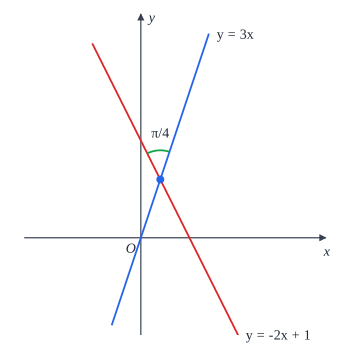
直线 y = 3x 和 y = -2x + 1 交于一点,两线所成的锐角是 π/4

解答 傾きは m1=3m_1 = 3,m2=−2m_2 = -2 で,1+m1m2=−5≠01 + m_1m_2 = -5 \ne 0 である。2直線のなす角の公式より

tan⁡θ=∣3−(−2)1+3×(−2)∣=∣5−5∣=1\tan\theta = \left|\frac{3 - (-2)}{1 + 3 \times (-2)}\right| = \left|\frac{5}{-5}\right| = 1

であるから,θ=π4\theta = \dfrac{\pi}{4} である。

中文翻译 题目:设两条直线 y=3xy = 3x 与 y=−2x+1y = -2x + 1 所成的锐角为 θ\theta,求 θ\theta。解答:斜率 m1=3m_1 = 3,m2=−2m_2 = -2,1+m1m2=−5≠01 + m_1m_2 = -5 \ne 0。由两直线所成角的公式,tan⁡θ=∣3−(−2)1+3×(−2)∣=∣5−5∣=1\tan\theta = \left|\dfrac{3 - (-2)}{1 + 3 \times (-2)}\right| = \left|\dfrac{5}{-5}\right| = 1,所以 θ=π4\theta = \dfrac{\pi}{4}。

解说 另一种解法:用向量。两条直线的方向向量取 (1,3)(1, 3) 和 (1,−2)(1, -2),夹角余弦 ∣1−6∣105=552=12\dfrac{|1 - 6|}{\sqrt{10}\sqrt{5}} = \dfrac{5}{5\sqrt{2}} = \dfrac{1}{\sqrt{2}},同样得 π4\dfrac{\pi}{4}(本书第 16 章)。斜率公式一步出 tan⁡θ\tan\theta,适合题目给斜率、问 tan⁡θ\tan\theta 的誘導;向量法不怕直线竖直(斜率不存在),适合直线用一般式或参数给出的时候。公式带绝对值,取的是锐角;没有绝对值会得到 tan⁡θ=−1\tan\theta = -1,对应补角 3π4\dfrac{3\pi}{4}。

例 5 (场景:积或和凑不成特殊角)

問題 sin⁡75∘cos⁡15∘\sin 75^\circ\cos 15^\circ と sin⁡75∘+sin⁡15∘\sin 75^\circ + \sin 15^\circ の値を求めよ。

解答 積を和に直す公式より

sin⁡75∘cos⁡15∘=12{sin⁡90∘+sin⁡60∘}=12(1+32)=2+34.\sin 75^\circ\cos 15^\circ = \frac{1}{2}\{\sin 90^\circ + \sin 60^\circ\} = \frac{1}{2}\left(1 + \frac{\sqrt{3}}{2}\right) = \frac{2 + \sqrt{3}}{4}.

和を積に直す公式より

sin⁡75∘+sin⁡15∘=2sin⁡45∘cos⁡30∘=2⋅22⋅32=62.\sin 75^\circ + \sin 15^\circ = 2\sin 45^\circ\cos 30^\circ = 2 \cdot \frac{\sqrt{2}}{2} \cdot \frac{\sqrt{3}}{2} = \frac{\sqrt{6}}{2}.

中文翻译 题目:求 sin⁡75∘cos⁡15∘\sin 75^\circ\cos 15^\circ 和 sin⁡75∘+sin⁡15∘\sin 75^\circ + \sin 15^\circ 的值。解答:由积化和差公式,sin⁡75∘cos⁡15∘=12{sin⁡90∘+sin⁡60∘}=12(1+32)=2+34\sin 75^\circ\cos 15^\circ = \dfrac{1}{2}\{\sin 90^\circ + \sin 60^\circ\} = \dfrac{1}{2}\left(1 + \dfrac{\sqrt{3}}{2}\right) = \dfrac{2 + \sqrt{3}}{4}。由和差化积公式,sin⁡75∘+sin⁡15∘=2sin⁡45∘cos⁡30∘=2⋅22⋅32=62\sin 75^\circ + \sin 15^\circ = 2\sin 45^\circ\cos 30^\circ = 2 \cdot \dfrac{\sqrt{2}}{2} \cdot \dfrac{\sqrt{3}}{2} = \dfrac{\sqrt{6}}{2}。

解说 另一种解法:cos⁡15∘=sin⁡75∘\cos 15^\circ = \sin 75^\circ,所以第一个就是 sin⁡275∘=1−cos⁡150∘2=1+322=2+34\sin^2 75^\circ = \dfrac{1 - \cos 150^\circ}{2} = \dfrac{1 + \frac{\sqrt{3}}{2}}{2} = \dfrac{2 + \sqrt{3}}{4}(半角公式)。积和公式通用;看出两角互余时,换成平方再用半角公式更快。用积和公式时,角是 α+β\alpha + \beta 与 α−β\alpha - \beta,相加、相减的顺序别弄反。

  • 积和公式的其余三个,都是加法定理两式相加减:cos⁡αsin⁡β=12{sin⁡(α+β)−sin⁡(α−β)}\cos\alpha\sin\beta = \dfrac{1}{2}\{\sin(\alpha + \beta) - \sin(\alpha - \beta)\},cos⁡αcos⁡β=12{cos⁡(α+β)+cos⁡(α−β)}\cos\alpha\cos\beta = \dfrac{1}{2}\{\cos(\alpha + \beta) + \cos(\alpha - \beta)\},sin⁡αsin⁡β=−12{cos⁡(α+β)−cos⁡(α−β)}\sin\alpha\sin\beta = -\dfrac{1}{2}\{\cos(\alpha + \beta) - \cos(\alpha - \beta)\}。
  • 和积公式的其余三个:sin⁡A−sin⁡B=2cos⁡A+B2sin⁡A−B2\sin A - \sin B = 2\cos\dfrac{A + B}{2}\sin\dfrac{A - B}{2},cos⁡A+cos⁡B=2cos⁡A+B2cos⁡A−B2\cos A + \cos B = 2\cos\dfrac{A + B}{2}\cos\dfrac{A - B}{2},cos⁡A−cos⁡B=−2sin⁡A+B2sin⁡A−B2\cos A - \cos B = -2\sin\dfrac{A + B}{2}\sin\dfrac{A - B}{2}。推导:在对应的积和公式里令 A=α+βA = \alpha + \beta,B=α−βB = \alpha - \beta。
  • cos⁡36∘=1+54\cos 36^\circ = \dfrac{1 + \sqrt{5}}{4}。推导:cos⁡36∘=1−2sin⁡218∘\cos 36^\circ = 1 - 2\sin^2 18^\circ,代入例 3 的结果。
  • tan⁡α=t\tan\alpha = t 时,sin⁡2α=2t1+t2\sin 2\alpha = \dfrac{2t}{1 + t^2},cos⁡2α=1−t21+t2\cos 2\alpha = \dfrac{1 - t^2}{1 + t^2}。推导:sin⁡2α=2sin⁡αcos⁡α=2tan⁡α1+tan⁡2α\sin 2\alpha = 2\sin\alpha\cos\alpha = \dfrac{2\tan\alpha}{1 + \tan^2\alpha}(分子分母同除以 cos⁡2α\cos^2\alpha,并用 sin⁡2α+cos⁡2α=1\sin^2\alpha + \cos^2\alpha = 1),余弦同理。
  • 两直线垂直 ⟺\Longleftrightarrow m1m2=−1m_1 m_2 = -1,就是 2直線のなす角 公式分母为 0 的情形。
  • 错在哪:例 1 中因为 α\alpha 在第二象限,给 cos⁡α2\cos\dfrac{\alpha}{2} 取了负号。 为什么错:开方后的符号由 α2\dfrac{\alpha}{2} 的象限决定,α2\dfrac{\alpha}{2} 在 π4\dfrac{\pi}{4} 和 π2\dfrac{\pi}{2} 之间,余弦为正。 正确做法:先把 α\alpha 的范围除以 2,写出 α2\dfrac{\alpha}{2} 的范围,再开方定号。
  • 错在哪:把 3倍角公式写成 cos⁡3α=3cos⁡α−4cos⁡3α\cos 3\alpha = 3\cos\alpha - 4\cos^3\alpha。 为什么错:把正弦的形式搬到了余弦上。取 α=0\alpha = 0 检验:左边 cos⁡0=1\cos 0 = 1,右边 3−4=−13 - 4 = -1,不对。 正确做法:记不清时用 α=0\alpha = 0 检验余弦式(4−3=14 - 3 = 1),用 α=π2\alpha = \dfrac{\pi}{2} 检验正弦式(sin⁡3π2=−1=3−4\sin\dfrac{3\pi}{2} = -1 = 3 - 4)。
  • 错在哪:求两直线所成的角时没有取绝对值,得出 tan⁡θ=−1\tan\theta = -1,θ=3π4\theta = \dfrac{3\pi}{4}。 为什么错:「2直線のなす角」约定取 0<θ≤π20 < \theta \le \dfrac{\pi}{2} 的那个角,负的正切对应的是它的补角。 正确做法:公式带绝对值;题目若另有规定(例如“从 ℓ\ell 转到 mm 的角”),按题目的规定。
  • 错在哪:和积公式写成 sin⁡A+sin⁡B=2sin⁡A+B2sin⁡A−B2\sin A + \sin B = 2\sin\dfrac{A + B}{2}\sin\dfrac{A - B}{2}。 为什么错:取 A=B=π2A = B = \dfrac{\pi}{2} 检验,左边 2,右边 0。 正确做法:记“正弦的和 = 2 正余”,不放心就由积和公式现推。

3倍角:cos⁡3α=4cos⁡3α−3cos⁡α\cos 3\alpha = 4\cos^3\alpha - 3\cos\alpha 说的是,单位圆上转 α\alpha 的点横坐标是 xx,转 3α3\alpha 的点横坐标就是 4x3−3x4x^3 - 3x。所以“转 θ\theta 和转 3θ3\theta 的两个点”这类题,用 t=cos⁡θt = \cos\theta 一换,就成了关于 tt 的 3 次函数。

2直線のなす角:每条直线的斜率是它倾斜角的正切。两条直线所成的角是两个倾斜角之差,差角的正切正好是加法定理里的 tan⁡(α−β)\tan(\alpha - \beta)。

积和:sin⁡αcos⁡β\sin\alpha\cos\beta 是 sin⁡(α+β)\sin(\alpha + \beta) 和 sin⁡(α−β)\sin(\alpha - \beta) 的平均数,两个波叠加后取一半。

  • 前置:国内书第 13 章 13.2 节(加法定理)、13.3 节(2倍角)、13.5 节(降幂与半角,和本节的半角公式是同一组式子)。
  • 国内书第 28 章:直线的倾斜角与斜率,2直線のなす角 用的就是倾斜角的差。
  • 后续:13.5 节,3倍角公式把 3θ3\theta 的式子化成 t=cos⁡θt = \cos\theta 或 t=sin⁡θt = \sin\theta 的 3 次函数。
  • 后续:本书第 21 章 微分法,3 次函数求增减和最值。
  • 后续:本书第 22 章 積分法,积和公式把 sin⁡mxcos⁡nx\sin mx\cos nx 化成和再积分,降幂(半角)公式用来积 sin⁡2x\sin^2 x。
  • 常一起考:本书第 16 章 ベクトル,两直线所成的角也可以用方向向量的内积求。

13.4 三角関数の合成(範囲つきの最大・最小)

Section titled “13.4 三角関数の合成(範囲つきの最大・最小)”

国内的辅助角公式(国内书第 13 章 13.4 节),日本叫三角関数の合成,“合成する”就是把两项化成一项。日本教科书的写法:

asin⁡θ+bcos⁡θ=rsin⁡(θ+α),r=a2+b2,a\sin\theta + b\cos\theta = r\sin(\theta + \alpha),\qquad r = \sqrt{a^2 + b^2},

其中角 α\alpha 满足 cos⁡α=ar\cos\alpha = \dfrac{a}{r},sin⁡α=br\sin\alpha = \dfrac{b}{r},就是点 P(a,b)P(a, b) 的動径与 xx 轴正方向所成的角。和国内只有字母不同:国内写 φ\varphi,日本写 α\alpha,取值一般在 −π<α≤π-\pi < \alpha \le \pi。

EJU 的考法和国内有三点不同:

  1. 填空形式固定:题干写好 Asin⁡(θ+πB)\fbox{A}\sin\left(\theta + \dfrac{\pi}{\fbox{B}}\right) 或 Asin⁡(2θ−πB)\fbox{A}\sin\left(2\theta - \dfrac{\pi}{\fbox{B}}\right),按格子的形状合成,不要合成余弦。
  2. 一定带范围:θ\theta 的范围常是 0≤θ≤π0 \le \theta \le \pi、0≤θ≤π20 \le \theta \le \dfrac{\pi}{2},最值要按 θ+α\theta + \alpha 的范围求,经常在端点取到,而不是 ±r\pm r。
  3. α\alpha 不是特殊角时,题干写「ただし,α\alpha は sin⁡α=45\sin\alpha = \dfrac{4}{5},cos⁡α=35\cos\alpha = \dfrac{3}{5} を満たす角とする」,求最值时用 α\alpha 表示 θ\theta,或者只比较端点的值。
  • 求 asin⁡θ+bcos⁡θa\sin\theta + b\cos\theta 在给定范围上的最大值、最小值及取到时的 θ\theta:合成后算 θ+α\theta + \alpha 的范围,在单位圆上读最值。
  • 式子里有 sin⁡2θ\sin^2\theta、sin⁡θcos⁡θ\sin\theta\cos\theta、cos⁡2θ\cos^2\theta:用 2倍角和半角公式化成 psin⁡2θ+qcos⁡2θ+cp\sin 2\theta + q\cos 2\theta + c,再合成。
  • 方程或不等式 asin⁡θ+bcos⁡θ=ca\sin\theta + b\cos\theta = c:合成后变成 13.2 节的 sin⁡(θ+α)=cr\sin(\theta + \alpha) = \dfrac{c}{r}。
  • 合成后 α\alpha 不是特殊角:用题干给的 sin⁡α\sin\alpha、cos⁡α\cos\alpha,比较端点的值或用 α\alpha 表示取最值时的 θ\theta。
  • 合成前先看清 sin⁡\sin 的系数是 aa、cos⁡\cos 的系数是 bb,点是 (a,b)(a, b)。sin⁡θ−3cos⁡θ\sin\theta - \sqrt{3}\cos\theta 的点是 (1,−3)(1, -\sqrt{3}),在第四象限,α=−π3\alpha = -\dfrac{\pi}{3}。
  • 范围换算:0≤θ≤π0 \le \theta \le \pi 时,θ−π3\theta - \dfrac{\pi}{3} 的范围是 −π3≤θ−π3≤2π3-\dfrac{\pi}{3} \le \theta - \dfrac{\pi}{3} \le \dfrac{2\pi}{3}。
  • 角是 2θ2\theta 时,2θ2\theta 的范围也要翻倍再加 α\alpha。
  • 只有同一个角的 sin⁡\sin 和 cos⁡\cos 才能合成;sin⁡2θ+cos⁡θ\sin 2\theta + \cos\theta 不能合成。
  • 题目要求「最大値をとるときの θ\theta の値」,最值点可能有两个(0≤θ<2π0 \le \theta < 2\pi 且角是 2θ2\theta 时),要全部写出。

同国内书第 13 章 13.4 节:提出 r=a2+b2r = \sqrt{a^2 + b^2},(ar)2+(br)2=1\left(\dfrac{a}{r}\right)^2 + \left(\dfrac{b}{r}\right)^2 = 1,所以点 (ar,br)\left(\dfrac{a}{r}, \dfrac{b}{r}\right) 在单位圆上,存在 α\alpha 使 cos⁡α=ar\cos\alpha = \dfrac{a}{r},sin⁡α=br\sin\alpha = \dfrac{b}{r}。代入加法定理:

asin⁡θ+bcos⁡θ=r(sin⁡θcos⁡α+cos⁡θsin⁡α)=rsin⁡(θ+α).a\sin\theta + b\cos\theta = r(\sin\theta\cos\alpha + \cos\theta\sin\alpha) = r\sin(\theta + \alpha).

(关键一步:提出的必须是 a2+b2\sqrt{a^2 + b^2},这样两个系数的平方和才等于 1,才能当作同一个角的余弦和正弦。)

带范围的最值:设 u=θ+αu = \theta + \alpha,θ\theta 在闭区间 p≤θ≤qp \le \theta \le q 上时,uu 在 p+α≤u≤q+αp + \alpha \le u \le q + \alpha 上。rsin⁡ur\sin u 的最值只能在 u=π2+2nπu = \dfrac{\pi}{2} + 2n\pi(最大)、u=−π2+2nπu = -\dfrac{\pi}{2} + 2n\pi(最小)或区间端点取到:sin⁡u\sin u 在不含这些点的区间上单调(国内书第 12 章 12.3 节)。所以只要比较“区间内的顶点”和“两个端点”。

例 1 (场景:带范围的最值)

問題 0≦θ≦π0 \leqq \theta \leqq \pi のとき,y=sin⁡θ−3cos⁡θy = \sin\theta - \sqrt{3}\cos\theta の最大値と最小値,およびそのときの θ\theta の値を求めよ。

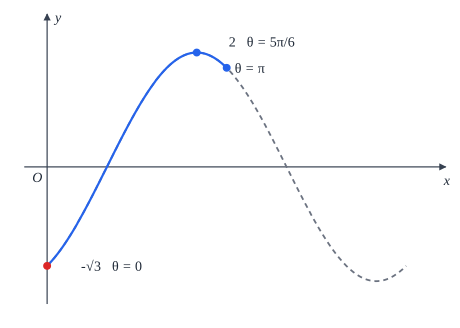
y = 2 sin(θ − π/3) 的图像,0 ≦ θ ≦ π 只取实线一段:最高点 θ = 5π/6,最低点在左端 θ = 0,值 −√3

解答 a=1a = 1,b=−3b = -\sqrt{3} より r=2r = 2 で,cos⁡α=12\cos\alpha = \dfrac{1}{2},sin⁡α=−32\sin\alpha = -\dfrac{\sqrt{3}}{2} を満たす角は α=−π3\alpha = -\dfrac{\pi}{3} である。よって

y=2sin⁡(θ−π3).y = 2\sin\left(\theta - \frac{\pi}{3}\right).

0≦θ≦π0 \leqq \theta \leqq \pi より −π3≦θ−π3≦2π3-\dfrac{\pi}{3} \leqq \theta - \dfrac{\pi}{3} \leqq \dfrac{2\pi}{3} である。この範囲で sin⁡(θ−π3)\sin\left(\theta - \dfrac{\pi}{3}\right) が最大になるのは θ−π3=π2\theta - \dfrac{\pi}{3} = \dfrac{\pi}{2} のときで,その値は 11;最小になるのは左端 θ−π3=−π3\theta - \dfrac{\pi}{3} = -\dfrac{\pi}{3} のときで,その値は sin⁡(−π3)=−32\sin\left(-\dfrac{\pi}{3}\right) = -\dfrac{\sqrt{3}}{2} である。

したがって,θ=5π6\theta = \dfrac{5\pi}{6} のとき最大値 22,θ=0\theta = 0 のとき最小値 −3-\sqrt{3} をとる。

中文翻译 题目:0≦θ≦π0 \leqq \theta \leqq \pi 时,求 y=sin⁡θ−3cos⁡θy = \sin\theta - \sqrt{3}\cos\theta 的最大值、最小值以及取到时的 θ\theta。解答:a=1a = 1,b=−3b = -\sqrt{3},r=2r = 2,满足 cos⁡α=12\cos\alpha = \dfrac{1}{2},sin⁡α=−32\sin\alpha = -\dfrac{\sqrt{3}}{2} 的角是 α=−π3\alpha = -\dfrac{\pi}{3}。所以 y=2sin⁡(θ−π3)y = 2\sin\left(\theta - \dfrac{\pi}{3}\right)。由 0≦θ≦π0 \leqq \theta \leqq \pi 得 −π3≦θ−π3≦2π3-\dfrac{\pi}{3} \leqq \theta - \dfrac{\pi}{3} \leqq \dfrac{2\pi}{3}。这个范围内 sin⁡(θ−π3)\sin\left(\theta - \dfrac{\pi}{3}\right) 在 θ−π3=π2\theta - \dfrac{\pi}{3} = \dfrac{\pi}{2} 时最大,其值为 11;在左端 θ−π3=−π3\theta - \dfrac{\pi}{3} = -\dfrac{\pi}{3} 时最小,其值为 sin⁡(−π3)=−32\sin\left(-\dfrac{\pi}{3}\right) = -\dfrac{\sqrt{3}}{2}。因此 θ=5π6\theta = \dfrac{5\pi}{6} 时取最大值 22,θ=0\theta = 0 时取最小值 −3-\sqrt{3}。

解说 容易卡在:最小值直接写 −2-2。−2-2 要在 θ−π3=−π2\theta - \dfrac{\pi}{3} = -\dfrac{\pi}{2} 时取到,而这个角不在范围里。合成后第一件事是写出括号里整体的范围,再在单位圆上读最值;带范围时最值常在端点取到。

例 2 (场景:含 sin⁡2θ\sin^2\theta、sin⁡θcos⁡θ\sin\theta\cos\theta、cos⁡2θ\cos^2\theta)

問題 0≦θ≦π20 \leqq \theta \leqq \dfrac{\pi}{2} のとき,y=sin⁡2θ+2sin⁡θcos⁡θ+3cos⁡2θy = \sin^2\theta + 2\sin\theta\cos\theta + 3\cos^2\theta の最大値と最小値を求めよ。

解答 sin⁡2θ=1−cos⁡2θ2\sin^2\theta = \dfrac{1 - \cos 2\theta}{2},cos⁡2θ=1+cos⁡2θ2\cos^2\theta = \dfrac{1 + \cos 2\theta}{2},2sin⁡θcos⁡θ=sin⁡2θ2\sin\theta\cos\theta = \sin 2\theta より

y=1−cos⁡2θ2+sin⁡2θ+3(1+cos⁡2θ)2=sin⁡2θ+cos⁡2θ+2=2sin⁡(2θ+π4)+2.y = \frac{1 - \cos 2\theta}{2} + \sin 2\theta + \frac{3(1 + \cos 2\theta)}{2} = \sin 2\theta + \cos 2\theta + 2 = \sqrt{2}\sin\left(2\theta + \frac{\pi}{4}\right) + 2.

0≦2θ≦π0 \leqq 2\theta \leqq \pi より π4≦2θ+π4≦5π4\dfrac{\pi}{4} \leqq 2\theta + \dfrac{\pi}{4} \leqq \dfrac{5\pi}{4} であるから,sin⁡(2θ+π4)\sin\left(2\theta + \dfrac{\pi}{4}\right) のとりうる値の範囲は −22-\dfrac{\sqrt{2}}{2} 以上 11 以下である。

  • 最大値 2+2\sqrt{2} + 2:2θ+π4=π22\theta + \dfrac{\pi}{4} = \dfrac{\pi}{2},すなわち θ=π8\theta = \dfrac{\pi}{8} のとき。
  • 最小値 2⋅(−22)+2=1\sqrt{2} \cdot \left(-\dfrac{\sqrt{2}}{2}\right) + 2 = 1:2θ+π4=5π42\theta + \dfrac{\pi}{4} = \dfrac{5\pi}{4},すなわち θ=π2\theta = \dfrac{\pi}{2} のとき。

中文翻译 题目:0≦θ≦π20 \leqq \theta \leqq \dfrac{\pi}{2} 时,求 y=sin⁡2θ+2sin⁡θcos⁡θ+3cos⁡2θy = \sin^2\theta + 2\sin\theta\cos\theta + 3\cos^2\theta 的最大值和最小值。解答:由 sin⁡2θ=1−cos⁡2θ2\sin^2\theta = \dfrac{1 - \cos 2\theta}{2},cos⁡2θ=1+cos⁡2θ2\cos^2\theta = \dfrac{1 + \cos 2\theta}{2},2sin⁡θcos⁡θ=sin⁡2θ2\sin\theta\cos\theta = \sin 2\theta,得 y=1−cos⁡2θ2+sin⁡2θ+3(1+cos⁡2θ)2=sin⁡2θ+cos⁡2θ+2=2sin⁡(2θ+π4)+2y = \dfrac{1 - \cos 2\theta}{2} + \sin 2\theta + \dfrac{3(1 + \cos 2\theta)}{2} = \sin 2\theta + \cos 2\theta + 2 = \sqrt{2}\sin\left(2\theta + \dfrac{\pi}{4}\right) + 2。由 0≦2θ≦π0 \leqq 2\theta \leqq \pi 得 π4≦2θ+π4≦5π4\dfrac{\pi}{4} \leqq 2\theta + \dfrac{\pi}{4} \leqq \dfrac{5\pi}{4},所以 sin⁡(2θ+π4)\sin\left(2\theta + \dfrac{\pi}{4}\right) 的取值范围是 −22-\dfrac{\sqrt{2}}{2} 到 11。最大值 2+2\sqrt{2} + 2:2θ+π4=π22\theta + \dfrac{\pi}{4} = \dfrac{\pi}{2},即 θ=π8\theta = \dfrac{\pi}{8}。最小值 2⋅(−22)+2=1\sqrt{2} \cdot \left(-\dfrac{\sqrt{2}}{2}\right) + 2 = 1:2θ+π4=5π42\theta + \dfrac{\pi}{4} = \dfrac{5\pi}{4},即 θ=π2\theta = \dfrac{\pi}{2}。

解说 验算:θ=π2\theta = \dfrac{\pi}{2} 时 y=1+0+0=1y = 1 + 0 + 0 = 1。步骤固定:先用 2倍角、半角公式化成 psin⁡2θ+qcos⁡2θ+cp\sin 2\theta + q\cos 2\theta + c,再合成,最后按 θ\theta 的范围换算括号里整体的范围。角是 2θ2\theta 时范围要翻倍再加 α\alpha,容易在这里少乘 2。

例 3 (场景:合成后解方程)

問題 0≦θ<2π0 \leqq \theta < 2\pi のとき,方程式 3sin⁡θ+cos⁡θ=1\sqrt{3}\sin\theta + \cos\theta = 1 を解け。

解答 r=2r = 2 で,点 (3,1)(\sqrt{3}, 1) に対応する角は α=π6\alpha = \dfrac{\pi}{6} であるから,2sin⁡(θ+π6)=12\sin\left(\theta + \dfrac{\pi}{6}\right) = 1,すなわち sin⁡(θ+π6)=12\sin\left(\theta + \dfrac{\pi}{6}\right) = \dfrac{1}{2} である。

π6≦θ+π6<13π6\dfrac{\pi}{6} \leqq \theta + \dfrac{\pi}{6} < \dfrac{13\pi}{6} の範囲で正弦が 12\dfrac{1}{2} になる角は π6\dfrac{\pi}{6},5π6\dfrac{5\pi}{6} である(13π6\dfrac{13\pi}{6} は範囲に含まれない)。よって θ=0\theta = 0,2π3\dfrac{2\pi}{3} である。

中文翻译 题目:0≦θ<2π0 \leqq \theta < 2\pi 时,解方程 3sin⁡θ+cos⁡θ=1\sqrt{3}\sin\theta + \cos\theta = 1。解答:r=2r = 2,点 (3,1)(\sqrt{3}, 1) 对应的角是 α=π6\alpha = \dfrac{\pi}{6},所以 2sin⁡(θ+π6)=12\sin\left(\theta + \dfrac{\pi}{6}\right) = 1,即 sin⁡(θ+π6)=12\sin\left(\theta + \dfrac{\pi}{6}\right) = \dfrac{1}{2}。在 π6≦θ+π6<13π6\dfrac{\pi}{6} \leqq \theta + \dfrac{\pi}{6} < \dfrac{13\pi}{6} 的范围内,正弦为 12\dfrac{1}{2} 的角是 π6\dfrac{\pi}{6},5π6\dfrac{5\pi}{6}(13π6\dfrac{13\pi}{6} 不在范围内)。所以 θ=0\theta = 0,2π3\dfrac{2\pi}{3}。

解说 验算 θ=2π3\theta = \dfrac{2\pi}{3}:3⋅32+(−12)=1\sqrt{3} \cdot \dfrac{\sqrt{3}}{2} + \left(-\dfrac{1}{2}\right) = 1。另一种解法:两边平方容易产生增根,不推荐。可以把 cos⁡θ=1−3sin⁡θ\cos\theta = 1 - \sqrt{3}\sin\theta 代入 sin⁡2θ+cos⁡2θ=1\sin^2\theta + \cos^2\theta = 1,得 4sin⁡2θ−23sin⁡θ=04\sin^2\theta - 2\sqrt{3}\sin\theta = 0,sin⁡θ=0\sin\theta = 0 或 32\dfrac{\sqrt{3}}{2},再逐个代回原方程检验:θ=0\theta = 0 成立,θ=π\theta = \pi 不成立;θ=π3\theta = \dfrac{\pi}{3} 不成立,θ=2π3\theta = \dfrac{2\pi}{3} 成立。代入法不用合成,但必须逐个检验;合成法一步到位,EJU 誘導基本都走合成。

例 4 (场景:α\alpha 不是特殊角)

問題 0≦θ≦π20 \leqq \theta \leqq \dfrac{\pi}{2} のとき,y=3sin⁡θ+4cos⁡θy = 3\sin\theta + 4\cos\theta の最大値と最小値を求めよ。

解答 r=9+16=5r = \sqrt{9 + 16} = 5 で,y=5sin⁡(θ+α)y = 5\sin(\theta + \alpha),ただし cos⁡α=35\cos\alpha = \dfrac{3}{5},sin⁡α=45\sin\alpha = \dfrac{4}{5},0<α<π20 < \alpha < \dfrac{\pi}{2} である。

θ+α\theta + \alpha のとりうる値の範囲は α≦θ+α≦π2+α\alpha \leqq \theta + \alpha \leqq \dfrac{\pi}{2} + \alpha である。0<α<π20 < \alpha < \dfrac{\pi}{2} より,この範囲は π2\dfrac{\pi}{2} を含むので,最大値 55 をとるのは θ=π2−α\theta = \dfrac{\pi}{2} - \alpha のときである。

最小値は端点で比べる。θ=0\theta = 0 のとき y=5sin⁡α=4y = 5\sin\alpha = 4,θ=π2\theta = \dfrac{\pi}{2} のとき y=5sin⁡(π2+α)=5cos⁡α=3y = 5\sin\left(\dfrac{\pi}{2} + \alpha\right) = 5\cos\alpha = 3 である。よって最小値 33 をとるのは θ=π2\theta = \dfrac{\pi}{2} のときである。

中文翻译 题目:0≦θ≦π20 \leqq \theta \leqq \dfrac{\pi}{2} 时,求 y=3sin⁡θ+4cos⁡θy = 3\sin\theta + 4\cos\theta 的最大值和最小值。解答:r=9+16=5r = \sqrt{9 + 16} = 5,y=5sin⁡(θ+α)y = 5\sin(\theta + \alpha),其中 cos⁡α=35\cos\alpha = \dfrac{3}{5},sin⁡α=45\sin\alpha = \dfrac{4}{5},0<α<π20 < \alpha < \dfrac{\pi}{2}。θ+α\theta + \alpha 的取值范围是 α≦θ+α≦π2+α\alpha \leqq \theta + \alpha \leqq \dfrac{\pi}{2} + \alpha。因为 0<α<π20 < \alpha < \dfrac{\pi}{2},这个范围包含 π2\dfrac{\pi}{2},所以最大值是 55,在 θ=π2−α\theta = \dfrac{\pi}{2} - \alpha 时取到。最小值在端点比较:θ=0\theta = 0 时 y=5sin⁡α=4y = 5\sin\alpha = 4,θ=π2\theta = \dfrac{\pi}{2} 时 y=5sin⁡(π2+α)=5cos⁡α=3y = 5\sin\left(\dfrac{\pi}{2} + \alpha\right) = 5\cos\alpha = 3。所以最小值是 33,在 θ=π2\theta = \dfrac{\pi}{2} 时取到。

解说 另一种解法:最小值不必合成,直接代端点:y(0)=4y(0) = 4,y(π2)=3y\left(\dfrac{\pi}{2}\right) = 3,而 yy 在 θ+α=π2\theta + \alpha = \dfrac{\pi}{2} 之前递增、之后递减,最小值只能在端点,取 3。最大值也可以用柯西不等式(向量内积)看:(3,4)⋅(sin⁡θ,cos⁡θ)≦5×1(3, 4) \cdot (\sin\theta, \cos\theta) \leqq 5 \times 1。合成法能同时说明取最大值时的 θ\theta;端点比较适合只问最小值的空格。

  • asin⁡θ+bcos⁡θa\sin\theta + b\cos\theta(θ\theta 取全体实数)的值域是 −a2+b2≤y≤a2+b2-\sqrt{a^2 + b^2} \le y \le \sqrt{a^2 + b^2}。
  • 三个常用的合成:sin⁡θ+cos⁡θ=2sin⁡(θ+π4)\sin\theta + \cos\theta = \sqrt{2}\sin\left(\theta + \dfrac{\pi}{4}\right),3sin⁡θ+cos⁡θ=2sin⁡(θ+π6)\sqrt{3}\sin\theta + \cos\theta = 2\sin\left(\theta + \dfrac{\pi}{6}\right),sin⁡θ+3cos⁡θ=2sin⁡(θ+π3)\sin\theta + \sqrt{3}\cos\theta = 2\sin\left(\theta + \dfrac{\pi}{3}\right)。
  • psin⁡2θ+qsin⁡θcos⁡θ+scos⁡2θ=q2sin⁡2θ+s−p2cos⁡2θ+p+s2p\sin^2\theta + q\sin\theta\cos\theta + s\cos^2\theta = \dfrac{q}{2}\sin 2\theta + \dfrac{s - p}{2}\cos 2\theta + \dfrac{p + s}{2}。推导:例 2 的做法换成字母。
  • 方程 asin⁡θ+bcos⁡θ=ca\sin\theta + b\cos\theta = c 有实数解 ⟺\Longleftrightarrow c2≤a2+b2c^2 \le a^2 + b^2。推导:合成后 sin⁡(θ+α)=cr\sin(\theta + \alpha) = \dfrac{c}{r} 要求 ∣cr∣≤1\left|\dfrac{c}{r}\right| \le 1。
  • 错在哪:例 1 的最小值写成 −2-2。 为什么错:θ\theta 有范围,θ−π3\theta - \dfrac{\pi}{3} 只在 −π3-\dfrac{\pi}{3} 到 2π3\dfrac{2\pi}{3} 之间,取不到 −π2-\dfrac{\pi}{2}。 正确做法:合成后第一件事是写出括号里整体的范围,再在单位圆上读最值。
  • 错在哪:sin⁡θ−3cos⁡θ\sin\theta - \sqrt{3}\cos\theta 合成成 2sin⁡(θ+π3)2\sin\left(\theta + \dfrac{\pi}{3}\right)。 为什么错:点是 (1,−3)(1, -\sqrt{3}),在第四象限,α=−π3\alpha = -\dfrac{\pi}{3};符号看错了。 正确做法:合成后展开验算一次:2sin⁡(θ−π3)=sin⁡θ−3cos⁡θ2\sin\left(\theta - \dfrac{\pi}{3}\right) = \sin\theta - \sqrt{3}\cos\theta。
  • 错在哪:把 3sin⁡θ+cos⁡θ\sqrt{3}\sin\theta + \cos\theta 中的 aa、bb 弄反,得 α=π3\alpha = \dfrac{\pi}{3}。 为什么错:α\alpha 由 cos⁡α=ar\cos\alpha = \dfrac{a}{r} 定,aa 是 sin⁡θ\sin\theta 的系数 3\sqrt{3},cos⁡α=32\cos\alpha = \dfrac{\sqrt{3}}{2},α=π6\alpha = \dfrac{\pi}{6}。 正确做法:记“点 (sin⁡(\sin 的系数,cos⁡\cos 的系数))”,画点再读角。
  • 错在哪:例 2 中 2θ+π42\theta + \dfrac{\pi}{4} 的范围写成 π4\dfrac{\pi}{4} 到 3π4\dfrac{3\pi}{4}。 为什么错:θ≤π2\theta \le \dfrac{\pi}{2} 时 2θ≤π2\theta \le \pi,忘了乘 2。 正确做法:先写 2θ2\theta 的范围,再加 α\alpha。

把 asin⁡θ+bcos⁡θa\sin\theta + b\cos\theta 看成向量 (a,b)(a, b) 与单位向量 (sin⁡θ,cos⁡θ)(\sin\theta, \cos\theta) 的内积。单位向量绕着转,内积最大是两向量同向时的 a2+b2\sqrt{a^2 + b^2},最小是反向时的 −a2+b2-\sqrt{a^2 + b^2}。θ\theta 有范围,就是单位向量只能转过一段弧;这段弧里如果转不到“同向”的位置,最大值就只能在端点。

合成后的图像是振幅 rr 的正弦曲线,平移了 −α-\alpha。带范围的最值,就是在这条曲线上截一段,看这一段的最高点和最低点(例 1 的图)。

  • 前置:国内书第 13 章 13.4 节(辅助角公式,内容相同)、13.5 节(降幂,例 2 的第一步)。
  • 前置:国内书第 12 章 12.5 节,y=Asin⁡(ωx+φ)y = A\sin(\omega x + \varphi) 的性质。
  • 后续:13.2 节,合成后解限定范围的方程、不等式。
  • 后续:13.5 节,t=sin⁡θ+cos⁡θ=2sin⁡(θ+π4)t = \sin\theta + \cos\theta = \sqrt{2}\sin\left(\theta + \dfrac{\pi}{4}\right) 的范围靠合成求。
  • 常一起考:本书第 17 章 複素数平面,asin⁡θ+bcos⁡θa\sin\theta + b\cos\theta 也可以看成复数乘法的虚部;本书第 16 章 ベクトル,内积的最值。

13.5 置き換えによる誘導(t = sin θ + cos θ,t = cos θ など)

Section titled “13.5 置き換えによる誘導(t = sin θ + cos θ,t = cos θ など)”

EJU コース2 的三角函数大题,最常见的骨架是“换元”:题干写「t=sin⁡θ+cos⁡θt = \sin\theta + \cos\theta とおく」或「t=cos⁡θt = \cos\theta とおく」,一步步把式子化成 tt 的 2 次或 3 次函数,再求最值、解的个数。国内书讲过最简单的两种(第 12 章 12.3 节 t=sin⁡xt = \sin x,第 13 章 13.4 节 t=sin⁡x+cos⁡xt = \sin x + \cos x 化成 2 次函数),EJU 多出的是:换成 3 次函数后接微分,以及“一个 tt 对应几个 θ\theta“的计数。

三种常见的换元:

换元 用到的关系 tt 的范围(0≤θ<2π0 \le \theta < 2\pi)
t=sin⁡θt = \sin\theta 或 t=cos⁡θt = \cos\theta cos⁡2θ=1−t2\cos^2\theta = 1 - t^2,cos⁡2θ=1−2t2\cos 2\theta = 1 - 2t^2,3倍角公式 −1≤t≤1-1 \le t \le 1
t=sin⁡θ+cos⁡θt = \sin\theta + \cos\theta sin⁡θcos⁡θ=t2−12\sin\theta\cos\theta = \dfrac{t^2 - 1}{2},sin⁡2θ=t2−1\sin 2\theta = t^2 - 1 −2≤t≤2-\sqrt{2} \le t \le \sqrt{2}
t=sin⁡θ−cos⁡θt = \sin\theta - \cos\theta sin⁡θcos⁡θ=1−t22\sin\theta\cos\theta = \dfrac{1 - t^2}{2} −2≤t≤2-\sqrt{2} \le t \le \sqrt{2}

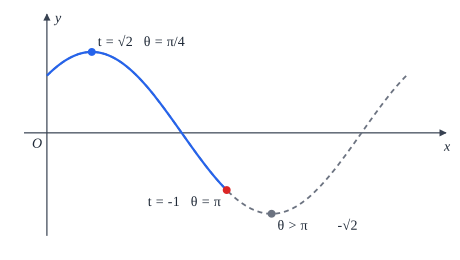
θ\theta 的范围变了,tt 的范围要重新算。t=sin⁡θ+cos⁡θ=2sin⁡(θ+π4)t = \sin\theta + \cos\theta = \sqrt{2}\sin\left(\theta + \dfrac{\pi}{4}\right) 在 0≤θ≤π0 \le \theta \le \pi 上的范围是 −1≤t≤2-1 \le t \le \sqrt{2},不是 −2≤t≤2-\sqrt{2} \le t \le \sqrt{2}。

t = √2 sin(θ + π/4) 的图像:θ 只在 0 到 π 之间时取实线一段,t 从 √2 降到 −1,到不了 −√2

换元誘導的流程:设 t,立刻求 t 的范围,改写成 t 的 2 次或 3 次函数,配方或微分,最后回到 θ 数解的个数

  • 式子里同时有 sin⁡θ+cos⁡θ\sin\theta + \cos\theta 和 sin⁡θcos⁡θ\sin\theta\cos\theta(或 sin⁡2θ\sin 2\theta):设 t=sin⁡θ+cos⁡θt = \sin\theta + \cos\theta,化成 tt 的 2 次函数。
  • 式子里有 sin⁡3θ+cos⁡3θ\sin^3\theta + \cos^3\theta,或者有 3θ3\theta、2θ2\theta、θ\theta 的余弦(正弦)混在一起:设 t=sin⁡θ+cos⁡θt = \sin\theta + \cos\theta 或 t=cos⁡θt = \cos\theta,化成 3 次函数,用微分求增减。
  • 问方程在给定范围里有几个解,或者解的个数随参数 kk 怎么变:先看 tt 的方程有几个根,再看每个 tt 对应几个 θ\theta。
  • 设 tt 之后,立刻写出 tt 的范围,整道题的最值和解的个数都靠它。
  • t=sin⁡θ+cos⁡θt = \sin\theta + \cos\theta 的范围用合成求:t=2sin⁡(θ+π4)t = \sqrt{2}\sin\left(\theta + \dfrac{\pi}{4}\right)。
  • 回到 θ\theta 时数清对应关系:0≤θ<2π0 \le \theta < 2\pi 时,−2<t<2-\sqrt{2} < t < \sqrt{2} 的每个 tt 对应两个 θ\theta,t=±2t = \pm\sqrt{2} 各对应一个。0≤θ≤π20 \le \theta \le \dfrac{\pi}{2} 时,t=sin⁡θt = \sin\theta 单调,一个 tt 对应一个 θ\theta。
  • 3 次函数的微分是数学Ⅱ的内容,EJU 认为考生已会;求出极值后还要和区间端点的值比较。
  • EJU 题干的说法:「t=sin⁡θ+cos⁡θt = \sin\theta + \cos\theta とおくと」「tt のとりうる値の範囲は A≦t≦B\fbox{A} \leqq t \leqq \sqrt{\fbox{B}} である」「yy を tt の式で表すと」「異なる解の個数」。

结论 1:t=sin⁡θ+cos⁡θt = \sin\theta + \cos\theta 时 sin⁡θcos⁡θ=t2−12\sin\theta\cos\theta = \dfrac{t^2 - 1}{2}。 两边平方:

t2=sin⁡2θ+2sin⁡θcos⁡θ+cos⁡2θ=1+2sin⁡θcos⁡θ.t^2 = \sin^2\theta + 2\sin\theta\cos\theta + \cos^2\theta = 1 + 2\sin\theta\cos\theta.

(关键一步:平方后 sin⁡2θ+cos⁡2θ\sin^2\theta + \cos^2\theta 合成 1,剩下的正好是要的积。)移项即得。t=sin⁡θ−cos⁡θt = \sin\theta - \cos\theta 时同样平方,得 t2=1−2sin⁡θcos⁡θt^2 = 1 - 2\sin\theta\cos\theta。

结论 2:sin⁡3θ+cos⁡3θ=t(3−t2)2\sin^3\theta + \cos^3\theta = \dfrac{t(3 - t^2)}{2}。 用立方和公式和结论 1:

sin⁡3θ+cos⁡3θ=(sin⁡θ+cos⁡θ)(sin⁡2θ−sin⁡θcos⁡θ+cos⁡2θ)=t(1−t2−12)=t(3−t2)2.\sin^3\theta + \cos^3\theta = (\sin\theta + \cos\theta)(\sin^2\theta - \sin\theta\cos\theta + \cos^2\theta) = t\left(1 - \frac{t^2 - 1}{2}\right) = \frac{t(3 - t^2)}{2}.

结论 3:一个 tt 对应几个 θ\theta。 t=2sin⁡ut = \sqrt{2}\sin u,u=θ+π4u = \theta + \dfrac{\pi}{4}。0≤θ<2π0 \le \theta < 2\pi 时 uu 走一整圈,由 13.2 节“证明”,sin⁡u=t2\sin u = \dfrac{t}{\sqrt{2}} 在 ∣t2∣<1\left|\dfrac{t}{\sqrt{2}}\right| < 1 时有两个解,等于 ±1\pm 1 时一个。

例 1 (场景:t=sin⁡θ+cos⁡θt = \sin\theta + \cos\theta 化成 2 次函数)

問題 0≦θ≦π0 \leqq \theta \leqq \pi のとき,y=sin⁡θ+cos⁡θ−2sin⁡θcos⁡θy = \sin\theta + \cos\theta - 2\sin\theta\cos\theta の最大値と最小値を求めよ。

解答 t=sin⁡θ+cos⁡θ=2sin⁡(θ+π4)t = \sin\theta + \cos\theta = \sqrt{2}\sin\left(\theta + \dfrac{\pi}{4}\right) とおく。π4≦θ+π4≦5π4\dfrac{\pi}{4} \leqq \theta + \dfrac{\pi}{4} \leqq \dfrac{5\pi}{4} より −22≦sin⁡(θ+π4)≦1-\dfrac{\sqrt{2}}{2} \leqq \sin\left(\theta + \dfrac{\pi}{4}\right) \leqq 1 であるから,

−1≦t≦2.-1 \leqq t \leqq \sqrt{2}.

2sin⁡θcos⁡θ=t2−12\sin\theta\cos\theta = t^2 - 1 であるから

y=t−(t2−1)=−t2+t+1=−(t−12)2+54.y = t - (t^2 - 1) = -t^2 + t + 1 = -\left(t - \frac{1}{2}\right)^2 + \frac{5}{4}.
  • 最大値:t=12t = \dfrac{1}{2} は範囲に含まれるから,t=12t = \dfrac{1}{2} のとき最大値 54\dfrac{5}{4} をとる。
  • 最小値:頂点から遠い端点で比べる。t=−1t = -1 のとき y=−1y = -1,t=2t = \sqrt{2} のとき y=2−1y = \sqrt{2} - 1 であるから,最小値は −1-1 である。このとき 2sin⁡(θ+π4)=−1\sqrt{2}\sin\left(\theta + \dfrac{\pi}{4}\right) = -1,θ+π4=5π4\theta + \dfrac{\pi}{4} = \dfrac{5\pi}{4},すなわち θ=π\theta = \pi である。

中文翻译 题目:0≦θ≦π0 \leqq \theta \leqq \pi 时,求 y=sin⁡θ+cos⁡θ−2sin⁡θcos⁡θy = \sin\theta + \cos\theta - 2\sin\theta\cos\theta 的最大值和最小值。解答:设 t=sin⁡θ+cos⁡θ=2sin⁡(θ+π4)t = \sin\theta + \cos\theta = \sqrt{2}\sin\left(\theta + \dfrac{\pi}{4}\right)。由 π4≦θ+π4≦5π4\dfrac{\pi}{4} \leqq \theta + \dfrac{\pi}{4} \leqq \dfrac{5\pi}{4} 得 −22≦sin⁡(θ+π4)≦1-\dfrac{\sqrt{2}}{2} \leqq \sin\left(\theta + \dfrac{\pi}{4}\right) \leqq 1,即 −1≦t≦2-1 \leqq t \leqq \sqrt{2}。由 2sin⁡θcos⁡θ=t2−12\sin\theta\cos\theta = t^2 - 1,y=t−(t2−1)=−t2+t+1=−(t−12)2+54y = t - (t^2 - 1) = -t^2 + t + 1 = -\left(t - \dfrac{1}{2}\right)^2 + \dfrac{5}{4}。最大值:t=12t = \dfrac{1}{2} 在范围内,t=12t = \dfrac{1}{2} 时取最大值 54\dfrac{5}{4}。最小值:比较离顶点远的端点,t=−1t = -1 时 y=−1y = -1,t=2t = \sqrt{2} 时 y=2−1y = \sqrt{2} - 1,所以最小值是 −1-1。此时 2sin⁡(θ+π4)=−1\sqrt{2}\sin\left(\theta + \dfrac{\pi}{4}\right) = -1,θ+π4=5π4\theta + \dfrac{\pi}{4} = \dfrac{5\pi}{4},即 θ=π\theta = \pi。

解说 容易卡在:tt 的范围写成 −2≦t≦2-\sqrt{2} \leqq t \leqq \sqrt{2},这时最小值会算成 −1−2-1 - \sqrt{2},而 θ≦π\theta \leqq \pi 根本到不了 t=−2t = -\sqrt{2}。每次换元都由 θ\theta 的实际范围重算 tt 的范围,必要时画 t=2sin⁡(θ+π4)t = \sqrt{2}\sin\left(\theta + \dfrac{\pi}{4}\right) 的图。

例 2 (场景:数解的个数)

問題 0≦θ<2π0 \leqq \theta < 2\pi のとき,方程式 sin⁡θ+cos⁡θ−sin⁡θcos⁡θ=1\sin\theta + \cos\theta - \sin\theta\cos\theta = 1 を解き,解の個数を求めよ。

解答 t=sin⁡θ+cos⁡θt = \sin\theta + \cos\theta(−2≦t≦2-\sqrt{2} \leqq t \leqq \sqrt{2})とおくと,sin⁡θcos⁡θ=t2−12\sin\theta\cos\theta = \dfrac{t^2 - 1}{2} であるから,

t−t2−12=1,t2−2t+1=0,t=1.t - \frac{t^2 - 1}{2} = 1, \quad t^2 - 2t + 1 = 0, \quad t = 1.

t=1t = 1 は −2-\sqrt{2} と 2\sqrt{2} の間にある。2sin⁡(θ+π4)=1\sqrt{2}\sin\left(\theta + \dfrac{\pi}{4}\right) = 1,sin⁡(θ+π4)=22\sin\left(\theta + \dfrac{\pi}{4}\right) = \dfrac{\sqrt{2}}{2} で,π4≦θ+π4<9π4\dfrac{\pi}{4} \leqq \theta + \dfrac{\pi}{4} < \dfrac{9\pi}{4} より θ+π4=π4\theta + \dfrac{\pi}{4} = \dfrac{\pi}{4},3π4\dfrac{3\pi}{4},すなわち θ=0\theta = 0,π2\dfrac{\pi}{2} である。

したがって,解は 22 個である。

中文翻译 题目:0≦θ<2π0 \leqq \theta < 2\pi 时,解方程 sin⁡θ+cos⁡θ−sin⁡θcos⁡θ=1\sin\theta + \cos\theta - \sin\theta\cos\theta = 1,并说出解的个数。解答:设 t=sin⁡θ+cos⁡θt = \sin\theta + \cos\theta(−2≦t≦2-\sqrt{2} \leqq t \leqq \sqrt{2}),sin⁡θcos⁡θ=t2−12\sin\theta\cos\theta = \dfrac{t^2 - 1}{2},所以 t−t2−12=1t - \dfrac{t^2 - 1}{2} = 1,t2−2t+1=0t^2 - 2t + 1 = 0,t=1t = 1。t=1t = 1 在 −2-\sqrt{2} 与 2\sqrt{2} 之间。由 2sin⁡(θ+π4)=1\sqrt{2}\sin\left(\theta + \dfrac{\pi}{4}\right) = 1,sin⁡(θ+π4)=22\sin\left(\theta + \dfrac{\pi}{4}\right) = \dfrac{\sqrt{2}}{2},π4≦θ+π4<9π4\dfrac{\pi}{4} \leqq \theta + \dfrac{\pi}{4} < \dfrac{9\pi}{4},得 θ+π4=π4\theta + \dfrac{\pi}{4} = \dfrac{\pi}{4},3π4\dfrac{3\pi}{4},即 θ=0\theta = 0,π2\dfrac{\pi}{2}。所以解有 22 个。

解说 验算:θ=0\theta = 0 时 0+1−0=10 + 1 - 0 = 1;θ=π2\theta = \dfrac{\pi}{2} 时 1+0−0=11 + 0 - 0 = 1。tt 的根个数不等于 θ\theta 的解个数:0≦θ<2π0 \leqq \theta < 2\pi 时,∣t∣<2|t| < \sqrt{2} 的每个 tt 对应两个 θ\theta,t=±2t = \pm\sqrt{2} 各对应一个。解出 tt 后回到 sin⁡(θ+π4)=t2\sin\left(\theta + \dfrac{\pi}{4}\right) = \dfrac{t}{\sqrt{2}},在单位圆上数交点。

例 3 (场景:3倍角化成 3 次函数,用微分)

問題 0≦θ≦π0 \leqq \theta \leqq \pi のとき,f(θ)=2cos⁡3θ+3cos⁡2θ−6cos⁡θf(\theta) = 2\cos 3\theta + 3\cos 2\theta - 6\cos\theta の最大値と最小値を求めよ。

解答 t=cos⁡θt = \cos\theta とおく。0≦θ≦π0 \leqq \theta \leqq \pi のとき −1≦t≦1-1 \leqq t \leqq 1 で,tt は θ\theta とともに単調に減少するから,tt と θ\theta は 11 対 11 に対応する。3倍角の公式と 2倍角の公式より

f=2(4t3−3t)+3(2t2−1)−6t=8t3+6t2−12t−3=g(t).f = 2(4t^3 - 3t) + 3(2t^2 - 1) - 6t = 8t^3 + 6t^2 - 12t - 3 = g(t).

微分すると

g′(t)=24t2+12t−12=12(2t−1)(t+1).g'(t) = 24t^2 + 12t - 12 = 12(2t - 1)(t + 1).

−1≦t≦1-1 \leqq t \leqq 1 の範囲で g′(t)=0g'(t) = 0 となるのは t=−1t = -1,t=12t = \dfrac{1}{2} である。−1<t<12-1 < t < \dfrac{1}{2} では g′(t)<0g'(t) < 0(減少),12<t<1\dfrac{1}{2} < t < 1 では g′(t)>0g'(t) > 0(増加)となる。値を比べると

g(−1)=−8+6+12−3=7,g(12)=1+32−6−3=−132,g(1)=8+6−12−3=−1.g(-1) = -8 + 6 + 12 - 3 = 7,\qquad g\left(\frac{1}{2}\right) = 1 + \frac{3}{2} - 6 - 3 = -\frac{13}{2},\qquad g(1) = 8 + 6 - 12 - 3 = -1.

よって,最大値は 77(t=−1t = -1,θ=π\theta = \pi),最小値は −132-\dfrac{13}{2}(t=12t = \dfrac{1}{2},θ=π3\theta = \dfrac{\pi}{3})である。

中文翻译 题目:0≦θ≦π0 \leqq \theta \leqq \pi 时,求 f(θ)=2cos⁡3θ+3cos⁡2θ−6cos⁡θf(\theta) = 2\cos 3\theta + 3\cos 2\theta - 6\cos\theta 的最大值和最小值。解答:设 t=cos⁡θt = \cos\theta。0≦θ≦π0 \leqq \theta \leqq \pi 时 −1≦t≦1-1 \leqq t \leqq 1,且 tt 随 θ\theta 单调递减,所以 tt 与 θ\theta 一一对应。由三倍角公式和二倍角公式,f=2(4t3−3t)+3(2t2−1)−6t=8t3+6t2−12t−3=g(t)f = 2(4t^3 - 3t) + 3(2t^2 - 1) - 6t = 8t^3 + 6t^2 - 12t - 3 = g(t)。求导:g′(t)=24t2+12t−12=12(2t−1)(t+1)g'(t) = 24t^2 + 12t - 12 = 12(2t - 1)(t + 1)。在 −1≦t≦1-1 \leqq t \leqq 1 上 g′(t)=0g'(t) = 0 的点是 t=−1t = -1,t=12t = \dfrac{1}{2}。−1<t<12-1 < t < \dfrac{1}{2} 时 g′(t)<0g'(t) < 0(递减),12<t<1\dfrac{1}{2} < t < 1 时 g′(t)>0g'(t) > 0(递增)。比较取值:g(−1)=−8+6+12−3=7g(-1) = -8 + 6 + 12 - 3 = 7,g(12)=1+32−6−3=−132g\left(\dfrac{1}{2}\right) = 1 + \dfrac{3}{2} - 6 - 3 = -\dfrac{13}{2},g(1)=8+6−12−3=−1g(1) = 8 + 6 - 12 - 3 = -1。所以最大值是 77(t=−1t = -1,θ=π\theta = \pi),最小值是 −132-\dfrac{13}{2}(t=12t = \dfrac{1}{2},θ=π3\theta = \dfrac{\pi}{3})。

解说 验算:f(π)=2cos⁡3π+3cos⁡2π−6cos⁡π=−2+3+6=7f(\pi) = 2\cos 3\pi + 3\cos 2\pi - 6\cos\pi = -2 + 3 + 6 = 7。容易卡在:cos⁡3θ\cos 3\theta 不会化,只好对 θ\theta 直接求导,得到 −6sin⁡3θ−6sin⁡2θ+6sin⁡θ-6\sin 3\theta - 6\sin 2\theta + 6\sin\theta,因式分解很难。先换元再求导,3 次函数一眼就能分析。闭区间上的最大值、最小值可能在端点取到,极值点和两个端点的值要一起比较。

  • t=sin⁡θ+cos⁡θt = \sin\theta + \cos\theta 时:sin⁡θcos⁡θ=t2−12\sin\theta\cos\theta = \dfrac{t^2 - 1}{2},sin⁡2θ=t2−1\sin 2\theta = t^2 - 1,sin⁡3θ+cos⁡3θ=t(3−t2)2\sin^3\theta + \cos^3\theta = \dfrac{t(3 - t^2)}{2}。推导见本节“证明”。
  • t=cos⁡θt = \cos\theta 时:cos⁡2θ=2t2−1\cos 2\theta = 2t^2 - 1,cos⁡3θ=4t3−3t\cos 3\theta = 4t^3 - 3t。t=sin⁡θt = \sin\theta 时:cos⁡2θ=1−2t2\cos 2\theta = 1 - 2t^2,sin⁡3θ=3t−4t3\sin 3\theta = 3t - 4t^3。来自 13.3 节。
  • t=sin⁡θ+cos⁡θt = \sin\theta + \cos\theta 的范围:0≤θ<2π0 \le \theta < 2\pi 时 −2≤t≤2-\sqrt{2} \le t \le \sqrt{2};0≤θ≤π0 \le \theta \le \pi 时 −1≤t≤2-1 \le t \le \sqrt{2};0≤θ≤π20 \le \theta \le \dfrac{\pi}{2} 时 1≤t≤21 \le t \le \sqrt{2}。推导:合成成 2sin⁡(θ+π4)\sqrt{2}\sin\left(\theta + \dfrac{\pi}{4}\right),按 13.4 节换算范围。
  • 解的个数 =∑= \sum(每个 tt 的根对应的 θ\theta 个数)。tt 的方程有两个根时,两个根分别数,再相加。
  • 错在哪:例 1 中 tt 的范围用了 −2≤t≤2-\sqrt{2} \le t \le \sqrt{2}。 为什么错:θ\theta 只在 00 到 π\pi 之间,θ+π4\theta + \dfrac{\pi}{4} 到不了 3π2\dfrac{3\pi}{2},tt 到不了 −2-\sqrt{2}。 正确做法:每次换元都由 θ\theta 的实际范围重算 tt 的范围,必要时画 t=2sin⁡(θ+π4)t = \sqrt{2}\sin\left(\theta + \dfrac{\pi}{4}\right) 的图。
  • 错在哪:sin⁡θcos⁡θ\sin\theta\cos\theta 写成 t2+12\dfrac{t^2 + 1}{2} 或 t2−1t^2 - 1。 为什么错:平方展开后移项时符号或系数 2 弄错。 正确做法:现场推一遍 t2=1+2sin⁡θcos⁡θt^2 = 1 + 2\sin\theta\cos\theta,用 θ=0\theta = 0 检验:t=1t = 1,sin⁡θcos⁡θ=0=1−12\sin\theta\cos\theta = 0 = \dfrac{1 - 1}{2}。
  • 错在哪:例 2 中 t=1t = 1 只算作一个解。 为什么错:tt 的根个数不等于 θ\theta 的解个数;0≤θ<2π0 \le \theta < 2\pi 时,∣t∣<2|t| < \sqrt{2} 的每个 tt 对应两个 θ\theta。 正确做法:解出 tt 后,回到 sin⁡(θ+π4)=t2\sin\left(\theta + \dfrac{\pi}{4}\right) = \dfrac{t}{\sqrt{2}},在单位圆上数交点。
  • 错在哪:例 3 中只比较了极值点,没算端点 g(1)g(1)。 为什么错:闭区间上的最大值、最小值可能在端点取到。 正确做法:把极值和两个端点的值一起列出来比较(本书第 21 章)。

换元是在“换一把尺子量同一个东西”。θ\theta 绕单位圆转,t=sin⁡θ+cos⁡θt = \sin\theta + \cos\theta 是点 P(cos⁡θ,sin⁡θ)P(\cos\theta, \sin\theta) 到直线 x+y=0x + y = 0 的有向距离乘以 2\sqrt{2}:PP 转一圈,tt 从 2\sqrt{2} 降到 −2-\sqrt{2} 再升回来,中间每个高度经过两次。这就是“一个 tt 对应两个 θ\theta”。

t=cos⁡θt = \cos\theta 就是 PP 的横坐标。θ\theta 从 0 转到 π\pi,PP 从右往左走过上半圆,横坐标从 1 单调降到 −1-1,所以这时一个 tt 对应一个 θ\theta。

  • 前置:国内书第 12 章 12.3 节(t=sin⁡xt = \sin x 换元成 2 次函数)、第 13 章 13.4 节(t=sin⁡x+cos⁡xt = \sin x + \cos x)。
  • 前置:13.3 节 3倍角公式,13.4 节合成(求 tt 的范围)。
  • 前置:本书第 5 章 2次関数(轴与区间的位置关系定最值);国内书第 25 章(3 次函数的单调性与极值)。
  • 后续:本书第 21 章 微分法,f(θ)f(\theta) 直接对 θ\theta 求导的做法,可以和换元对照。
  • 常一起考:本书第 12 章 指数関数・対数関数,t=2x+2−xt = 2^x + 2^{-x} 的换元是同一个套路。

三角函数只考コース2,很少单独成一个大问,多和微分、积分绑在一起,出现在大问 Ⅲ 或 Ⅳ:2019 年第 1 回コース2 的 Ⅲ 用单位圆上转 θ\theta 和 3θ3\theta 的两点,换元 t=cos⁡θt = \cos\theta 后微分求最大值;2020 年第 2 回コース2 的 Ⅳ 是 sin⁡x\sin x、sin⁡2x\sin 2x、sin⁡3x\sin 3x 组合的函数,先求导、用 cos⁡x\cos x 因式分解定增减,再积分求面积;2021 年第 1 回コース2 的 Ⅳ 是 y=sin⁡2xy = \sin^2 x 与 y=kcos⁡2xy = k\cos 2x 的交点和围成的面积。2020 年第 2 回コース2 的 Ⅲ 里也有一小问,用加法定理求两直线所成角的正切。

誘導的典型骨架:

  • 合成型:(1) 用 2倍角、半角把式子化成 psin⁡2θ+qcos⁡2θp\sin 2\theta + q\cos 2\theta →(2) 合成成 Asin⁡(2θ+πB)\fbox{A}\sin\left(2\theta + \dfrac{\pi}{\fbox{B}}\right) →(3) 在给定范围里求最值和取到时的 θ\theta →(4) 解 f(θ)=cf(\theta) = c,数解的个数。
  • 换元型:(1) t=sin⁡θ+cos⁡θt = \sin\theta + \cos\theta 的范围 →(2) 把式子写成 tt 的 2 次函数 →(3) 最值 →(4) 回到 θ\theta。
  • 3 次型:(1) 3倍角公式 →(2) t=sin⁡θt = \sin\theta 或 cos⁡θ\cos\theta,写成 3 次函数 →(3) 微分求增减、极值 →(4) f(θ)=kf(\theta) = k 的解的个数(看直线 y=ky = k 和图像的交点)。

填涂提醒:角度写成 CDπ\dfrac{\fbox{C}}{\fbox{D}}\pi 时分子分母分开填,π\pi 已印好;πB\dfrac{\pi}{\fbox{B}} 的分子 1 不占格;θ\theta 有两个值时按题目要求的顺序(通常从小到大)填。

問題 1 (合成と方程式)

0≦θ<2π0 \leqq \theta < 2\pi とする。関数

f(θ)=sin⁡2θ+23sin⁡θcos⁡θ−cos⁡2θf(\theta) = \sin^2\theta + 2\sqrt{3}\sin\theta\cos\theta - \cos^2\theta

について考える。

(1) 2倍角の公式を用いると,f(θ)=3sin⁡2θ−cos⁡2θf(\theta) = \sqrt{3}\sin 2\theta - \cos 2\theta となるから,

f(θ)=Asin⁡(2θ−πB)f(\theta) = \fbox{A}\sin\left(2\theta - \frac{\pi}{\fbox{B}}\right)

と表される。

(2) f(θ)f(\theta) の最大値は C\fbox{C} であり,最大値をとる θ\theta の値は θ=πD\theta = \dfrac{\pi}{\fbox{D}},EFπ\dfrac{\fbox{E}}{\fbox{F}}\pi である。

(3) 方程式 f(θ)=1f(\theta) = 1 を満たす θ\theta は G\fbox{G} 個あり,そのうち最も小さいものは θ=πH\theta = \dfrac{\pi}{\fbox{H}} である。

解答 (1) sin⁡2θ−cos⁡2θ=−cos⁡2θ\sin^2\theta - \cos^2\theta = -\cos 2\theta,2sin⁡θcos⁡θ=sin⁡2θ2\sin\theta\cos\theta = \sin 2\theta であるから,f(θ)=3sin⁡2θ−cos⁡2θf(\theta) = \sqrt{3}\sin 2\theta - \cos 2\theta である。点 (3,−1)(\sqrt{3}, -1) について r=2r = 2,α=−π6\alpha = -\dfrac{\pi}{6} であるから,f(θ)=2sin⁡(2θ−π6)f(\theta) = 2\sin\left(2\theta - \dfrac{\pi}{6}\right) と表される。よって A=2\fbox{A} = 2,B=6\fbox{B} = 6。

(2) u=2θ−π6u = 2\theta - \dfrac{\pi}{6} とおくと,−π6≦u<23π6-\dfrac{\pi}{6} \leqq u < \dfrac{23\pi}{6} である。最大値 22 をとるのは u=π2u = \dfrac{\pi}{2},5π2\dfrac{5\pi}{2} のときで,θ=π3\theta = \dfrac{\pi}{3},4π3\dfrac{4\pi}{3} である。よって C=2\fbox{C} = 2,D=3\fbox{D} = 3,E=4\fbox{E} = 4,F=3\fbox{F} = 3。

(3) f(θ)=1f(\theta) = 1 より sin⁡u=12\sin u = \dfrac{1}{2} である。u=π6u = \dfrac{\pi}{6},5π6\dfrac{5\pi}{6},13π6\dfrac{13\pi}{6},17π6\dfrac{17\pi}{6} はいずれも範囲に含まれ,θ=π6\theta = \dfrac{\pi}{6},π2\dfrac{\pi}{2},7π6\dfrac{7\pi}{6},3π2\dfrac{3\pi}{2} である。解は 44 個で,そのうち最も小さいものは θ=π6\theta = \dfrac{\pi}{6} である。よって G=4\fbox{G} = 4,H=6\fbox{H} = 6。

中文翻译 题目:设 0≦θ<2π0 \leqq \theta < 2\pi,考虑函数 f(θ)=sin⁡2θ+23sin⁡θcos⁡θ−cos⁡2θf(\theta) = \sin^2\theta + 2\sqrt{3}\sin\theta\cos\theta - \cos^2\theta。(1)用二倍角公式得 f(θ)=3sin⁡2θ−cos⁡2θf(\theta) = \sqrt{3}\sin 2\theta - \cos 2\theta,所以可以表示为 f(θ)=Asin⁡(2θ−πB)f(\theta) = \fbox{A}\sin\left(2\theta - \dfrac{\pi}{\fbox{B}}\right)。(2)f(θ)f(\theta) 的最大值是 C\fbox{C},取最大值的 θ\theta 是 πD\dfrac{\pi}{\fbox{D}} 和 EFπ\dfrac{\fbox{E}}{\fbox{F}}\pi。(3)满足 f(θ)=1f(\theta) = 1 的 θ\theta 有 G\fbox{G} 个,其中最小的是 θ=πH\theta = \dfrac{\pi}{\fbox{H}}。解答:(1)sin⁡2θ−cos⁡2θ=−cos⁡2θ\sin^2\theta - \cos^2\theta = -\cos 2\theta,2sin⁡θcos⁡θ=sin⁡2θ2\sin\theta\cos\theta = \sin 2\theta,所以 f(θ)=3sin⁡2θ−cos⁡2θf(\theta) = \sqrt{3}\sin 2\theta - \cos 2\theta。对点 (3,−1)(\sqrt{3}, -1),r=2r = 2,α=−π6\alpha = -\dfrac{\pi}{6},所以 f(θ)=2sin⁡(2θ−π6)f(\theta) = 2\sin\left(2\theta - \dfrac{\pi}{6}\right),A=2\fbox{A} = 2,B=6\fbox{B} = 6。(2)设 u=2θ−π6u = 2\theta - \dfrac{\pi}{6},则 −π6≦u<23π6-\dfrac{\pi}{6} \leqq u < \dfrac{23\pi}{6}。最大值 22 在 u=π2u = \dfrac{\pi}{2},5π2\dfrac{5\pi}{2} 时取到,θ=π3\theta = \dfrac{\pi}{3},4π3\dfrac{4\pi}{3},所以 C=2\fbox{C} = 2,D=3\fbox{D} = 3,E=4\fbox{E} = 4,F=3\fbox{F} = 3。(3)由 f(θ)=1f(\theta) = 1 得 sin⁡u=12\sin u = \dfrac{1}{2}。u=π6u = \dfrac{\pi}{6},5π6\dfrac{5\pi}{6},13π6\dfrac{13\pi}{6},17π6\dfrac{17\pi}{6} 都在范围内,θ=π6\theta = \dfrac{\pi}{6},π2\dfrac{\pi}{2},7π6\dfrac{7\pi}{6},3π2\dfrac{3\pi}{2}。解有 44 个,其中最小的是 θ=π6\theta = \dfrac{\pi}{6},所以 G=4\fbox{G} = 4,H=6\fbox{H} = 6。

解说 两分钟做法:先用 2倍角公式把 sin⁡2θ−cos⁡2θ\sin^2\theta - \cos^2\theta 化成 −cos⁡2θ-\cos 2\theta,得 3sin⁡2θ−cos⁡2θ\sqrt{3}\sin 2\theta - \cos 2\theta,再按点 (3,−1)(\sqrt{3}, -1) 合成;α\alpha 由 cos⁡α=32\cos\alpha = \dfrac{\sqrt{3}}{2}、sin⁡α=−12\sin\alpha = -\dfrac{1}{2} 定为 −π6-\dfrac{\pi}{6},题干已印负号,B\fbox{B} 只填 6。空格判断:A\fbox{A} 是振幅 2;C\fbox{C} 是最大值 2;D\fbox{D}、E/F\fbox{E}/\fbox{F} 是取最大值的两个 θ\theta,2θ2\theta 绕两圈,最大值取到两次;G\fbox{G} 是解的个数,sin⁡u=12\sin u = \dfrac{1}{2} 每个周期两个解,两圈共 4 个;H\fbox{H} 是最小的 θ\theta。验算:f(π6)=14+32−34=1f\left(\dfrac{\pi}{6}\right) = \dfrac{1}{4} + \dfrac{3}{2} - \dfrac{3}{4} = 1。

問題 2 (t=sin⁡θ+cos⁡θt = \sin\theta + \cos\theta の置き換え)

0≦θ≦π0 \leqq \theta \leqq \pi のとき,関数

y=sin⁡2θ−2(sin⁡θ+cos⁡θ)y = \sin 2\theta - \sqrt{2}(\sin\theta + \cos\theta)

の最大値と最小値を求めよう。

(1) t=sin⁡θ+cos⁡θt = \sin\theta + \cos\theta とおくと,t=Asin⁡(θ+πB)t = \sqrt{\fbox{A}}\sin\left(\theta + \dfrac{\pi}{\fbox{B}}\right) であるから,tt のとりうる値の範囲は −C≦t≦D-\fbox{C} \leqq t \leqq \sqrt{\fbox{D}} である。

(2) sin⁡2θ=t2−E\sin 2\theta = t^2 - \fbox{E} であるから,y=t2−F t−Gy = t^2 - \sqrt{\fbox{F}}\,t - \fbox{G} と表される。

(3) yy の最小値は −HI-\dfrac{\fbox{H}}{\fbox{I}} であり,そのとき θ=JKLπ\theta = \dfrac{\fbox{J}}{\fbox{KL}}\pi である。また,yy の最大値は M\sqrt{\fbox{M}} である。

解答 (1) t=sin⁡θ+cos⁡θ=2sin⁡(θ+π4)t = \sin\theta + \cos\theta = \sqrt{2}\sin\left(\theta + \dfrac{\pi}{4}\right) である。0≦θ≦π0 \leqq \theta \leqq \pi より π4≦θ+π4≦5π4\dfrac{\pi}{4} \leqq \theta + \dfrac{\pi}{4} \leqq \dfrac{5\pi}{4} であるから,−1≦t≦2-1 \leqq t \leqq \sqrt{2} である。よって A=2\fbox{A} = 2,B=4\fbox{B} = 4,C=1\fbox{C} = 1,D=2\fbox{D} = 2。

(2) t2=1+sin⁡2θt^2 = 1 + \sin 2\theta より sin⁡2θ=t2−1\sin 2\theta = t^2 - 1 である。よって y=t2−1−2t=t2−2t−1y = t^2 - 1 - \sqrt{2}t = t^2 - \sqrt{2}t - 1 で,E=1\fbox{E} = 1,F=2\fbox{F} = 2,G=1\fbox{G} = 1 である。

(3) y=(t−22)2−32y = \left(t - \dfrac{\sqrt{2}}{2}\right)^2 - \dfrac{3}{2} で,頂点 t=22t = \dfrac{\sqrt{2}}{2} は −1≦t≦2-1 \leqq t \leqq \sqrt{2} に含まれるから,最小値は −32-\dfrac{3}{2} である。このとき sin⁡(θ+π4)=12\sin\left(\theta + \dfrac{\pi}{4}\right) = \dfrac{1}{2} で,π4≦θ+π4≦5π4\dfrac{\pi}{4} \leqq \theta + \dfrac{\pi}{4} \leqq \dfrac{5\pi}{4} の範囲では θ+π4=5π6\theta + \dfrac{\pi}{4} = \dfrac{5\pi}{6} のみが適する(π6\dfrac{\pi}{6} は範囲に含まれない)。よって θ=5π6−π4=7π12\theta = \dfrac{5\pi}{6} - \dfrac{\pi}{4} = \dfrac{7\pi}{12} である。最大値は端点で比べ,t=−1t = -1 のとき y=1+2−1=2y = 1 + \sqrt{2} - 1 = \sqrt{2},t=2t = \sqrt{2} のとき y=2−2−1=−1y = 2 - 2 - 1 = -1 であるから,最大値は 2\sqrt{2}(θ=π\theta = \pi)である。よって H=3\fbox{H} = 3,I=2\fbox{I} = 2,J=7\fbox{J} = 7,K=1\fbox{K} = 1,L=2\fbox{L} = 2,M=2\fbox{M} = 2。

中文翻译 题目:0≦θ≦π0 \leqq \theta \leqq \pi 时,求函数 y=sin⁡2θ−2(sin⁡θ+cos⁡θ)y = \sin 2\theta - \sqrt{2}(\sin\theta + \cos\theta) 的最大值和最小值。(1)设 t=sin⁡θ+cos⁡θt = \sin\theta + \cos\theta,则 t=Asin⁡(θ+πB)t = \sqrt{\fbox{A}}\sin\left(\theta + \dfrac{\pi}{\fbox{B}}\right),所以 tt 的取值范围是 −C≦t≦D-\fbox{C} \leqq t \leqq \sqrt{\fbox{D}}。(2)sin⁡2θ=t2−E\sin 2\theta = t^2 - \fbox{E},所以 y=t2−F t−Gy = t^2 - \sqrt{\fbox{F}}\,t - \fbox{G}。(3)yy 的最小值是 −HI-\dfrac{\fbox{H}}{\fbox{I}},此时 θ=JKLπ\theta = \dfrac{\fbox{J}}{\fbox{KL}}\pi;yy 的最大值是 M\sqrt{\fbox{M}}。解答:(1)t=sin⁡θ+cos⁡θ=2sin⁡(θ+π4)t = \sin\theta + \cos\theta = \sqrt{2}\sin\left(\theta + \dfrac{\pi}{4}\right)。由 0≦θ≦π0 \leqq \theta \leqq \pi 得 π4≦θ+π4≦5π4\dfrac{\pi}{4} \leqq \theta + \dfrac{\pi}{4} \leqq \dfrac{5\pi}{4},所以 −1≦t≦2-1 \leqq t \leqq \sqrt{2},A=2\fbox{A} = 2,B=4\fbox{B} = 4,C=1\fbox{C} = 1,D=2\fbox{D} = 2。(2)由 t2=1+sin⁡2θt^2 = 1 + \sin 2\theta 得 sin⁡2θ=t2−1\sin 2\theta = t^2 - 1。所以 y=t2−1−2t=t2−2t−1y = t^2 - 1 - \sqrt{2}t = t^2 - \sqrt{2}t - 1,E=1\fbox{E} = 1,F=2\fbox{F} = 2,G=1\fbox{G} = 1。(3)y=(t−22)2−32y = \left(t - \dfrac{\sqrt{2}}{2}\right)^2 - \dfrac{3}{2},顶点 t=22t = \dfrac{\sqrt{2}}{2} 在 −1≦t≦2-1 \leqq t \leqq \sqrt{2} 内,最小值是 −32-\dfrac{3}{2}。此时 sin⁡(θ+π4)=12\sin\left(\theta + \dfrac{\pi}{4}\right) = \dfrac{1}{2},在 π4≦θ+π4≦5π4\dfrac{\pi}{4} \leqq \theta + \dfrac{\pi}{4} \leqq \dfrac{5\pi}{4} 内只有 θ+π4=5π6\theta + \dfrac{\pi}{4} = \dfrac{5\pi}{6} 合适(π6\dfrac{\pi}{6} 不在范围内),所以 θ=5π6−π4=7π12\theta = \dfrac{5\pi}{6} - \dfrac{\pi}{4} = \dfrac{7\pi}{12}。最大值比较端点:t=−1t = -1 时 y=1+2−1=2y = 1 + \sqrt{2} - 1 = \sqrt{2},t=2t = \sqrt{2} 时 y=2−2−1=−1y = 2 - 2 - 1 = -1,所以最大值是 2\sqrt{2}(θ=π\theta = \pi)。因此 H=3\fbox{H} = 3,I=2\fbox{I} = 2,J=7\fbox{J} = 7,K=1\fbox{K} = 1,L=2\fbox{L} = 2,M=2\fbox{M} = 2。

解说 两分钟做法:换元型固定四步——设 tt、立刻用合成求 tt 的范围、把 sin⁡2θ\sin 2\theta 换成 t2−1t^2 - 1、配方后比较顶点和两端点。空格判断:A\fbox{A} 是合成后振幅 2\sqrt{2} 的根号内 2;B\fbox{B} 是平移量 π4\dfrac{\pi}{4} 的分母 4;C\fbox{C} 题干已印负号,左端点的绝对值是 1;D\fbox{D} 是右端点 2\sqrt{2} 的根号内 2;E\fbox{E} 是 sin⁡2θ=t2−1\sin 2\theta = t^2 - 1 里的 1;F\fbox{F} 是 2t\sqrt{2}t 的根号内 2;G\fbox{G} 是常数项 1;H/I\fbox{H}/\fbox{I} 是最小值 32\dfrac{3}{2},分子 3、分母 2;J/KL\fbox{J}/\fbox{KL} 是 7π12\dfrac{7\pi}{12},分子 7、分母 12 占两格;M\fbox{M} 是最大值 2\sqrt{2} 的根号内 2。最小值在顶点取到;最大值在左端点 θ=π\theta = \pi,右端点 θ=π2\theta = \dfrac{\pi}{2} 的值是 −1-1,不是最大值。

問題 3 (3倍角の公式と微分)

0≦θ≦π20 \leqq \theta \leqq \dfrac{\pi}{2} のとき,関数 f(θ)=sin⁡3θ+3sin⁡θf(\theta) = \sin 3\theta + 3\sin\theta について考える。

(1) 3倍角の公式 sin⁡3θ=Asin⁡θ−Bsin⁡3θ\sin 3\theta = \fbox{A}\sin\theta - \fbox{B}\sin^3\theta を用い,t=sin⁡θt = \sin\theta とおくと,f(θ)=C t−D t3f(\theta) = \fbox{C}\,t - \fbox{D}\,t^3 である。ただし,0≦t≦10 \leqq t \leqq 1 である。

(2) g(t)=C t−D t3g(t) = \fbox{C}\,t - \fbox{D}\,t^3 とおく。g′(t)=0g'(t) = 0 となる tt は t=EFt = \dfrac{\sqrt{\fbox{E}}}{\fbox{F}} であり,f(θ)f(\theta) の最大値は GH\fbox{G}\sqrt{\fbox{H}},そのとき θ=πI\theta = \dfrac{\pi}{\fbox{I}} である。

(3) kk を実数とする。方程式 f(θ)=kf(\theta) = k が 0≦θ≦π20 \leqq \theta \leqq \dfrac{\pi}{2} の範囲に異なる 2 つの解をもつような kk の値の範囲は J≦k<KL\fbox{J} \leqq k < \fbox{K}\sqrt{\fbox{L}} である。

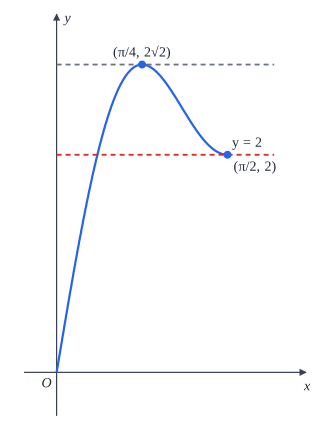
f(θ) = sin 3θ + 3 sin θ 在 0 ≦ θ ≦ π/2 上先升到 2√2 再降到 2,直线 y = k 在 k 不小于 2、又小于 2√2 时与它交两点

解答 (1) sin⁡3θ=3sin⁡θ−4sin⁡3θ\sin 3\theta = 3\sin\theta - 4\sin^3\theta である。t=sin⁡θt = \sin\theta とおくと,f(θ)=3t−4t3+3t=6t−4t3f(\theta) = 3t - 4t^3 + 3t = 6t - 4t^3 である。よって A=3\fbox{A} = 3,B=4\fbox{B} = 4,C=6\fbox{C} = 6,D=4\fbox{D} = 4 である。0≦θ≦π20 \leqq \theta \leqq \dfrac{\pi}{2} より 0≦t≦10 \leqq t \leqq 1 である。

(2) g(t)=6t−4t3g(t) = 6t - 4t^3 より g′(t)=6−12t2g'(t) = 6 - 12t^2 である。g′(t)=0g'(t) = 0 とすると t2=12t^2 = \dfrac{1}{2} で,t≧0t \geqq 0 より t=22t = \dfrac{\sqrt{2}}{2} である。よって E=2\fbox{E} = 2,F=2\fbox{F} = 2。

0≦t<220 \leqq t < \dfrac{\sqrt{2}}{2} では g′(t)>0g'(t) > 0(増加),22<t≦1\dfrac{\sqrt{2}}{2} < t \leqq 1 では g′(t)<0g'(t) < 0(減少)であるから,最大値は g(22)=32−4⋅24=22g\left(\dfrac{\sqrt{2}}{2}\right) = 3\sqrt{2} - 4 \cdot \dfrac{\sqrt{2}}{4} = 2\sqrt{2}。 このとき sin⁡θ=22\sin\theta = \dfrac{\sqrt{2}}{2},θ=π4\theta = \dfrac{\pi}{4} である。よって G=2\fbox{G} = 2,H=2\fbox{H} = 2,I=4\fbox{I} = 4。

(3) 0≦θ≦π20 \leqq \theta \leqq \dfrac{\pi}{2} のとき t=sin⁡θt = \sin\theta は単調に増加するから,tt と θ\theta は 11 対 11 に対応する。したがって,g(t)=kg(t) = k が 0≦t≦10 \leqq t \leqq 1 に異なる 22 つの解をもてばよい。g(0)=0g(0) = 0,g(22)=22g\left(\dfrac{\sqrt{2}}{2}\right) = 2\sqrt{2},g(1)=2g(1) = 2 であるから,直線 y=ky = k が y=g(t)y = g(t) のグラフと 22 点で交わるのは,kk が右端の値 22 以上で,最大値 222\sqrt{2} より小さいときである。よって 2≦k<222 \leqq k < 2\sqrt{2} で,J=2\fbox{J} = 2,K=2\fbox{K} = 2,L=2\fbox{L} = 2 である。

中文翻译 题目:0≦θ≦π20 \leqq \theta \leqq \dfrac{\pi}{2} 时,考虑函数 f(θ)=sin⁡3θ+3sin⁡θf(\theta) = \sin 3\theta + 3\sin\theta。(1)用三倍角公式 sin⁡3θ=Asin⁡θ−Bsin⁡3θ\sin 3\theta = \fbox{A}\sin\theta - \fbox{B}\sin^3\theta,设 t=sin⁡θt = \sin\theta,则 f(θ)=C t−D t3f(\theta) = \fbox{C}\,t - \fbox{D}\,t^3,其中 0≦t≦10 \leqq t \leqq 1。(2)设 g(t)=C t−D t3g(t) = \fbox{C}\,t - \fbox{D}\,t^3。使 g′(t)=0g'(t) = 0 的 tt 是 EF\dfrac{\sqrt{\fbox{E}}}{\fbox{F}},f(θ)f(\theta) 的最大值是 GH\fbox{G}\sqrt{\fbox{H}},此时 θ=πI\theta = \dfrac{\pi}{\fbox{I}}。(3)kk 是实数。方程 f(θ)=kf(\theta) = k 在 0≦θ≦π20 \leqq \theta \leqq \dfrac{\pi}{2} 内有两个不同解时,kk 的取值范围是 J≦k<KL\fbox{J} \leqq k < \fbox{K}\sqrt{\fbox{L}}。解答:(1)sin⁡3θ=3sin⁡θ−4sin⁡3θ\sin 3\theta = 3\sin\theta - 4\sin^3\theta。设 t=sin⁡θt = \sin\theta,f(θ)=3t−4t3+3t=6t−4t3f(\theta) = 3t - 4t^3 + 3t = 6t - 4t^3,所以 A=3\fbox{A} = 3,B=4\fbox{B} = 4,C=6\fbox{C} = 6,D=4\fbox{D} = 4。由 0≦θ≦π20 \leqq \theta \leqq \dfrac{\pi}{2} 得 0≦t≦10 \leqq t \leqq 1。(2)由 g(t)=6t−4t3g(t) = 6t - 4t^3 得 g′(t)=6−12t2g'(t) = 6 - 12t^2。令 g′(t)=0g'(t) = 0,t2=12t^2 = \dfrac{1}{2},由 t≧0t \geqq 0 得 t=22t = \dfrac{\sqrt{2}}{2},所以 E=2\fbox{E} = 2,F=2\fbox{F} = 2。0≦t<220 \leqq t < \dfrac{\sqrt{2}}{2} 时 g′(t)>0g'(t) > 0(递增),22<t≦1\dfrac{\sqrt{2}}{2} < t \leqq 1 时 g′(t)<0g'(t) < 0(递减),所以最大值是 g(22)=32−4⋅24=22g\left(\dfrac{\sqrt{2}}{2}\right) = 3\sqrt{2} - 4 \cdot \dfrac{\sqrt{2}}{4} = 2\sqrt{2}。此时 sin⁡θ=22\sin\theta = \dfrac{\sqrt{2}}{2},θ=π4\theta = \dfrac{\pi}{4},所以 G=2\fbox{G} = 2,H=2\fbox{H} = 2,I=4\fbox{I} = 4。(3)0≦θ≦π20 \leqq \theta \leqq \dfrac{\pi}{2} 时 t=sin⁡θt = \sin\theta 单调递增,所以 tt 与 θ\theta 一一对应。因此只要 g(t)=kg(t) = k 在 0≦t≦10 \leqq t \leqq 1 上有两个不同的解。g(0)=0g(0) = 0,g(22)=22g\left(\dfrac{\sqrt{2}}{2}\right) = 2\sqrt{2},g(1)=2g(1) = 2,直线 y=ky = k 与 y=g(t)y = g(t) 的图像交于两点,要求 kk 不小于右端的值 22、又小于最大值 222\sqrt{2},即 2≦k<222 \leqq k < 2\sqrt{2},J=2\fbox{J} = 2,K=2\fbox{K} = 2,L=2\fbox{L} = 2。

解说 两分钟做法:3 次型的固定套路——3倍角公式先把 sin⁡3θ\sin 3\theta 化成 sin⁡θ\sin\theta 的多项式,再设 t=sin⁡θt = \sin\theta,用微分定增减,最后比较极值和端点。空格判断:A\fbox{A}、B\fbox{B} 是 3倍角公式的系数 3、4;C\fbox{C}、D\fbox{D} 是合并同类项后的 6、4;E/F\fbox{E}/\fbox{F} 是 t=22t = \dfrac{\sqrt{2}}{2},根号内 2、分母 2;GH\fbox{G}\sqrt{\fbox{H}} 是 222\sqrt{2};I\fbox{I} 是取最大值时的 θ=π4\theta = \dfrac{\pi}{4}。第 (3) 问的端点:k=2k = 2 时右端点 θ=π2\theta = \dfrac{\pi}{2} 也是解,要取等号;k=22k = 2\sqrt{2} 时直线与曲线相切,只有一个解,不取等号。J\fbox{J} 与 K\fbox{K} 都填 2,容易只填一处。验算:f(π4)=22+322=22f\left(\dfrac{\pi}{4}\right) = \dfrac{\sqrt{2}}{2} + \dfrac{3\sqrt{2}}{2} = 2\sqrt{2}。

日文 读音 中文 例句或说明
三角関数 さんかくかんすう 三角函数 数学Ⅱ;数学Ⅰ的叫「三角比」
動径 どうけい 终边(射线) 「動径 OP の表す角」
始線 しせん 始边 xx 軸の正の部分
一般角 いっぱんかく 任意角 θ+360∘×n\theta + 360^\circ \times n(nn は整数)
弧度法 こどほう 弧度制 「弧度法で表すと」
ラジアン ラジアン 弧度 単位は普通省略する
単位円 たんいえん 单位圆 「単位円周上の点 P」
象限 しょうげん 象限 「第 2 象限の角」
周期 しゅうき (最小正)周期 「周期は π\pi である」
正弦曲線 せいげんきょくせん 正弦曲线 y=sin⁡θy = \sin\theta のグラフ
平行移動 へいこういどう 平移 「θ\theta 軸方向に π3\dfrac{\pi}{3} だけ平行移動」
θ 軸方向 シータじくほうこう 沿 θ 轴方向 横軸を θ\theta 軸とするグラフ
偶関数・奇関数 ぐうかんすう・きかんすう 偶函数・奇函数 cos⁡θ\cos\theta は偶関数
加法定理 かほうていり 两角和与差公式 「加法定理を用いて」
2倍角の公式 にばいかくのこうしき 二倍角公式
半角の公式 はんかくのこうしき 半角公式(含降幂) sin⁡2α2=1−cos⁡α2\sin^2\dfrac{\alpha}{2} = \dfrac{1 - \cos\alpha}{2}
3倍角の公式 さんばいかくのこうしき 三倍角公式 sin⁡3α=3sin⁡α−4sin⁡3α\sin 3\alpha = 3\sin\alpha - 4\sin^3\alpha
積を和に直す公式 せきをわになおすこうしき 积化和差公式 参考书也叫「積和の公式」「積を和・差に直す公式」
和を積に直す公式 わをせきになおすこうしき 和差化积公式 学习指导要领解说的说法是「三角関数の和を積に直すなどの公式」;参考书也叫「和積の公式」
三角関数の合成 さんかくかんすうのごうせい 辅助角公式 「rsin⁡(θ+α)r\sin(\theta + \alpha) の形に合成する」
合成する ごうせいする 合成(化成一项) 「sin⁡θ+cos⁡θ\sin\theta + \cos\theta を合成すると」
2直線のなす角 にちょくせんのなすかく 两直线所成的角 「2直線のなす角を θ\theta とする」
傾き かたむき 斜率 「傾き mm の直線」
〜とおく 〜とおく 设…… 「t=cos⁡θt = \cos\theta とおく」
置き換える おきかえる 换元 「tt に置き換える」
とりうる値の範囲 とりうるあたいのはんい 取值范围 「tt のとりうる値の範囲を求めよ」
最大値・最小値 さいだいち・さいしょうち 最大值・最小值 「最大値をとるときの θ\theta の値」
方程式を解け ほうていしきをとけ 解方程 「0≦θ<2π0 \leqq \theta < 2\pi のとき,方程式を解け」
異なる 2 つの解 ことなるふたつのかい 两个不同的解 「異なる 2 つの解をもつ」
解の個数 かいのこすう 解的个数
〜の範囲で 〜のはんいで 在……范围内 「0≦θ≦π0 \leqq \theta \leqq \pi の範囲で」
ただし,〜とする ただし,〜とする 其中,设…… 「ただし,α\alpha は sin⁡α=45\sin\alpha = \dfrac{4}{5} を満たす角とする」
  1. 0≤θ<2π0 \le \theta < 2\pi 时,解方程 tan⁡θ=−3\tan\theta = -\sqrt{3}。
  2. 0≤θ<2π0 \le \theta < 2\pi 时,解不等式 cos⁡2θ≤12\cos 2\theta \le \dfrac{1}{2}。
  3. cos⁡α=13\cos\alpha = \dfrac{1}{3},求 cos⁡3α\cos 3\alpha。
  4. 求直线 y=2xy = 2x 与 y=13xy = \dfrac{1}{3}x 所成的锐角。
  5. 0≤θ≤π0 \le \theta \le \pi 时,求 y=sin⁡θ+cos⁡θy = \sin\theta + \cos\theta 的最大值和最小值。
  6. 0≤θ<2π0 \le \theta < 2\pi 时,解方程 3sin⁡θ−cos⁡θ=2\sqrt{3}\sin\theta - \cos\theta = \sqrt{2}。
  7. 设 t=sin⁡θ−cos⁡θt = \sin\theta - \cos\theta(0≤θ≤π0 \le \theta \le \pi),用 tt 表示 sin⁡θcos⁡θ\sin\theta\cos\theta,并求 tt 的取值范围。
  8. 0≤θ<2π0 \le \theta < 2\pi 时,求 y=cos⁡2θ+2sin⁡θy = \cos 2\theta + 2\sin\theta 的最大值和最小值。

答案:1. θ=2π3\theta = \dfrac{2\pi}{3},5π3\dfrac{5\pi}{3};2. π6≤θ≤5π6\dfrac{\pi}{6} \le \theta \le \dfrac{5\pi}{6},7π6≤θ≤11π6\dfrac{7\pi}{6} \le \theta \le \dfrac{11\pi}{6};3. −2327-\dfrac{23}{27};4. π4\dfrac{\pi}{4};5. 最大值 2\sqrt{2}(θ=π4\theta = \dfrac{\pi}{4}),最小值 −1-1(θ=π\theta = \pi);6. θ=5π12\theta = \dfrac{5\pi}{12},11π12\dfrac{11\pi}{12};7. sin⁡θcos⁡θ=1−t22\sin\theta\cos\theta = \dfrac{1 - t^2}{2},−1≤t≤2-1 \le t \le \sqrt{2};8. 最大值 32\dfrac{3}{2},最小值 −3-3。